


Page 209 - Class-11-Physics-Part-1_Neat
P. 209
GRAVITATION 195
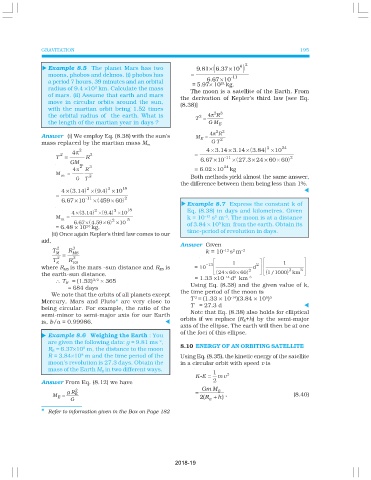
t Example 8.5 The planet Mars has two 9.81 ( × 6.37 ×10 6 ) 2
moons, phobos and delmos. (i) phobos has = -11
×10
6.67
a period 7 hours, 39 minutes and an orbital = 5.97× 10 kg.
24
radius of 9.4 ×10 km. Calculate the mass The moon is a satellite of the Earth. From
3
of mars. (ii) Assume that earth and mars the derivation of Kepler’s third law [see Eq.
move in circular orbits around the sun, (8.38)]
with the martian orbit being 1.52 times
the orbital radius of the earth. What is 2 4π 2 R 3
T =
the length of the martian year in days ? G M E
4π 2 R 3
Answer (i) We employ Eq. (8.38) with the sun’s M E =
G T 2
mass replaced by the martian mass M m
3 24
×
2 4 × 3.14 3.14 × (3.84 ) ×10
4π
2 3 =
T = R 6.67 ×10 -11 ( × 27.3 24 60 60 ) 2
×
×
×
GM
m 3 24
2
4π R = 6.02 10 kg
×
M =
m 2 Both methods yield almost the same answer,
G T
the difference between them being less than 1%.
2 3 18
(
4 ( × 3.14 ) × 9 4. ) ×10 t
= -11 2
6.67 ×10 ( × 459 60 )
×
t Example 8.7 Express the constant k of
2 3 18 Eq. (8.38) in days and kilometres. Given
(
4 × (3.14 ) × 9 4. ) ×10
2
–3
M = k = 10 –13 s m . The moon is at a distance
m 2 -5
6.67× (4.59 6× ) × 10 of 3.84 × 10 km from the earth. Obtain its
5
23
= 6.48 × 10 kg.
(ii) Once again Kepler’s third law comes to our time-period of revolution in days.
aid,
Answer Given
T 2 R 3 k = 10 –13 2 –3
s m
M MS
2 = 3
T R
E ES −13 1 2 1
where R MS is the mars -sun distance and R ES is = 10 2 d 3 3
×
×
the earth-sun distance. ( 24 60 60 ) –3 ( 1 1000/ ) km
2
–14
∴ T M = (1.52) 3/2 × 365 = 1.33 ×10 d km
= 684 days Using Eq. (8.38) and the given value of k,
We note that the orbits of all planets except the time period of the moon is 5 3
-14
2
Mercury, Mars and Pluto* are very close to T = (1.33 × 10 )(3.84 × 10 )
being circular. For example, the ratio of the T = 27.3 d t
semi-minor to semi-major axis for our Earth Note that Eq. (8.38) also holds for elliptical
is, b/a = 0.99986. t orbits if we replace (R E +h) by the semi-major
axis of the ellipse. The earth will then be at one
of the foci of this ellipse.
t Example 8.6 Weighing the Earth : You
are given the following data: g = 9.81 ms ,
–2
6
R E = 6.37×10 m, the distance to the moon 8.10 ENERGY OF AN ORBITING SATELLITE
R = 3.84×10 m and the time period of the Using Eq. (8.35), the kinetic energy of the satellite
8
moon’s revolution is 27.3 days. Obtain the in a circular orbit with speed v is
mass of the Earth M E in two different ways. 1
K E = m v 2
i
Answer From Eq. (8.12) we have 2
2 Gm M
R g = E
M = E 2(R + h ) , (8.40)
E
G E
* Refer to information given in the Box on Page 182
2018-19

