


Page 25 - Class-11-Physics-Part-1_Neat
P. 25
PHYSICAL WORLD                                                                              11

                potential energy is completely converted into the  the other end, all kinds of violent phenomena
                kinetic energy of the object just before it hits  occur in the universe all the time.  Yet the total
                the ground. This law restricted for a conservative  energy of the universe (the most ideal isolated
                force should not be confused with the general    system possible !) is believed to remain
                law of conservation of energy of an isolated     unchanged.
                system (which is the basis of the First Law of     Until the advent of Einstein’s theory of
                Thermodynamics).                                 relativity, the law of conservation of mass was
                  The concept of energy is central to physics    regarded as another basic conservation law of
                and the expressions for energy can be written    nature, since matter was thought to be
                for every physical system. When all forms of     indestructible. It was (and still is) an important
                energy e.g., heat, mechanical energy, electrical  principle used, for example, in the analysis of
                energy etc., are counted, it turns out that energy  chemical reactions. A chemical reaction is
                is conserved. The general law of conservation of  basically a rearrangement of atoms among
                energy is true for all forces and for any kind of  different molecules.  If the total binding energy
                transformation between different forms of        of the reacting molecules is less than the total
                energy. In the falling object example, if you    binding energy of the product molecules, the
                include the effect of air resistance during the  difference appears as heat and the reaction is
                fall and see the situation after the object hits  exothermic.  The opposite is true for energy
                the ground and stays there, the total            absorbing (endothermic) reactions.  However,
                mechanical energy is obviously not conserved.    since the atoms are merely rearranged but not
                The general law of energy conservation, however,  destroyed, the total mass of the reactants is the
                is still applicable.  The initial potential energy  same as the total mass of the products in a
                of the stone gets transformed into other forms   chemical reaction. The changes in the binding
                of energy : heat and sound. (Ultimately, sound   energy are too small to be measured as changes
                after it is absorbed becomes heat.) The total    in mass.
                energy of the system (stone plus the               According to Einstein’s theory, mass m is
                surroundings) remains unchanged.                 equivalent to energy E  given by the relation
                                                                       2
                  The law of conservation of energy is thought   E = mc , where c is speed of light in vacuum.
                to be valid across all domains of nature, from     In a nuclear process mass gets converted to
                the microscopic to the macroscopic. It is        energy (or vice-versa). This is the energy which
                routinely applied in the analysis of atomic,     is released in a nuclear power generation and
                nuclear and elementary particle processes.  At   nuclear explosions.


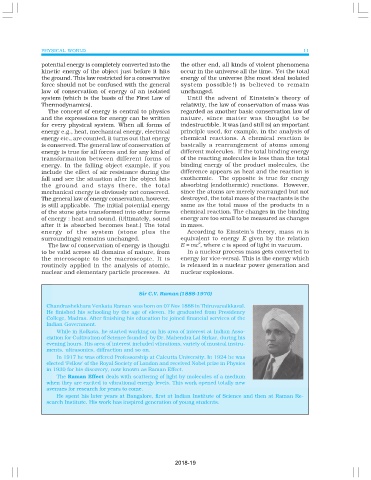
                                                  Sir C.V. Raman (1888-1970)

                  Chandrashekhara Venkata Raman  was born on 07 Nov 1888 in Thiruvanaikkaval.
                  He finished his schooling by the age of eleven. He graduated from Presidency
                  College, Madras. After finishing his education he joined financial services of the
                  Indian Government.
                     While in Kolkata, he started working on his area of interest at Indian Asso-
                  ciation for Cultivation of Science founded  by Dr. Mahendra Lal Sirkar, during his
                  evening hours. His area of interest included vibrations, variety of musical instru-
                  ments, ultrasonics, diffraction and so on.
                     In 1917 he was offered Professorship at Calcutta University. In 1924 he was
                  elected ‘Fellow’ of the Royal Society of London and received Nobel prize in Physics
                  in 1930 for his discovery, now known as Raman Effect.
                     The Raman Effect deals with scattering of light by molecules of a medium
                  when they are excited to vibrational energy levels. This work opened totally new
                  avenues for research for years to come.
                     He spent his later years at Bangalore, first at Indian Institute of Science and then at Raman Re-
                  search Institute. His work has inspired generation of young students.


                                                               2018-19

