


Page 23 - Class-11-Physics-Part-1_Neat
P. 23
PHYSICAL WORLD                                                                               9


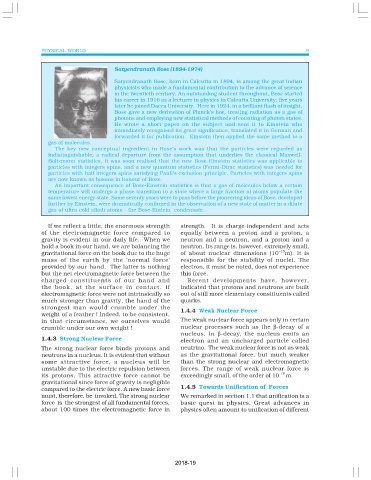
                                          Satyendranath Bose (1894-1974)

                                          Satyendranath Bose, born in Calcutta in 1894, is among the great Indian
                                          physicists who made a fundamental contribution to the advance of science
                                          in the twentieth century. An outstanding student throughout, Bose started
                                          his career in 1916 as a lecturer in physics in Calcutta University; five years
                                          later he joined Dacca University.  Here in 1924, in a brilliant flash of insight,
                                          Bose gave a new derivation of Planck’s law, treating radiation as a gas of
                                          photons and employing new statistical methods of counting of photon states.
                                          He wrote a short paper on the subject and sent it to Einstein who
                                          immediately recognised its great significance, translated it in German and
                                          forwarded it for publication.  Einstein then applied the same method to a
                  gas of molecules.
                    The key new conceptual ingredient in Bose’s work was that the particles were regarded as
                  indistinguishable, a radical departure from the assumption that underlies the classical Maxwell-
                  Boltzmann statistics. It was soon realised that the new Bose-Einstein statistics was applicable to
                  particles with integers spins, and a new quantum statistics (Fermi-Dirac statistics) was needed for
                  particles with half integers spins satisfying Pauli’s exclusion principle. Particles with integers spins
                  are now known as bosons in honour of Bose.
                    An important consequence of Bose-Einstein statistics is that a gas of molecules below a certain
                  temperature will undergo a phase transition to a state where a large fraction of atoms populate the
                  same lowest energy state. Some seventy years were to pass before the pioneering ideas of Bose, developed
                  further by Einstein, were dramatically confirmed in the observation of a new state of matter in a dilute
                  gas of ultra cold alkali atoms - the Bose-Eintein  condensate.

                  If we reflect a little, the enormous strength  strength.  It is charge-independent and acts
                of the electromagnetic force compared to         equally between a proton and a proton, a
                gravity is evident in our daily life.  When we   neutron and a neutron, and a proton and a
                hold a book in our hand, we are balancing the    neutron. Its range is, however, extremely small,
                gravitational force on the book due to the huge  of about nuclear dimensions (10    –15 m). It is
                mass of the earth by the ‘normal force’          responsible for the stability of nuclei. The
                provided by our hand.  The latter is nothing     electron, it must be noted, does not experience
                but the net electromagnetic force between the    this force.
                charged constituents of our hand and               Recent developments have, however,
                the book,   at the surface in contact. If        indicated that protons and neutrons are built
                electromagnetic force were not intrinsically so  out of still more elementary constituents called
                much stronger than gravity, the hand of the      quarks.
                strongest man would crumble under the
                                                                 1.4.4  Weak Nuclear Force
                weight of a feather ! Indeed, to be consistent,
                in that circumstance, we ourselves would         The weak nuclear force appears only in certain
                crumble under our own weight !                   nuclear processes such as the β-decay of a
                                                                 nucleus. In β-decay, the nucleus emits an
                1.4.3  Strong Nuclear Force
                                                                 electron and an uncharged particle called
                The strong nuclear force binds protons and       neutrino.  The weak nuclear force is not as weak
                neutrons in a nucleus. It is evident that without  as the gravitational force, but much weaker
                some attractive force, a nucleus will be         than the strong nuclear and electromagnetic
                unstable due to the electric repulsion between   forces. The range of weak nuclear force is
                its protons. This attractive force cannot be     exceedingly small, of the order of 10 –16  m.
                gravitational since force of gravity is negligible
                compared to the electric force. A new basic force  1.4.5  Towards Unification of  Forces
                must, therefore, be  invoked. The strong nuclear  We remarked in section 1.1 that unification is a
                force  is  the strongest of all fundamental forces,  basic quest in physics. Great advances in
                about 100 times the electromagnetic force in     physics often amount to unification of different


                                                               2018-19

