


Page 115 - SFG_ANNUALREPORT_12OCT_SINGLEPAGE
P. 115
The consolidated entity would look to raise capital when an opportunity to invest in a business or company was seen
as value adding relative to the current company’s share price at the time of the investment. The consolidated entity
is not actively pursuing additional investments in the short term as it continues to integrate and grow its existing
businesses in order to maximise synergies.

The consolidated entity is subject to certain financing arrangement covenants and meeting these is given priority in
all capital risk management decisions. There have been no events of default on the financing arrangements during the
financial year. Formal notification of this compliance is confirmed on a quarterly basis.

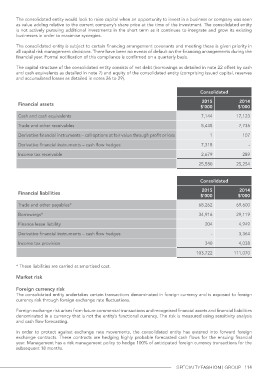
The capital structure of the consolidated entity consists of net debt (borrowings as detailed in note 22 offset by cash
and cash equivalents as detailed in note 7) and equity of the consolidated entity (comprising issued capital, reserves
and accumulated losses as detailed in notes 26 to 29).

Financial assets                                                                       Consolidated    2014
                                                                                        2015          $’000
Cash and cash equivalents                                                              $’000         17,123
Trade and other receivables                                                            7,144          7,735
Derivative financial instruments – call options at fair value through profit or loss   8,438
Derivative financial instruments – cash flow hedges                                                      107
Income tax receivable                                                                        1               -
                                                                                       7,318
                                                                                       2,679             289
                                                                                      25,580         25,254

                                                                                      Consolidated

Financial liabilities                                                                 2015           2014
                                                                                      $’000          $’000
Trade and other payables*
Borrowings*                                                                           68,262         69,600
Finance lease liability
Derivative financial instruments – cash flow hedges                                   34,916         29,119
Income tax provision
                                                                                      204 4,949

                                                                                      - 3,364

                                                                                      340 4,038

                                                                                      103,722        111,070

* These liabilities are carried at amortised cost.

Market risk

Foreign currency risk
The consolidated entity undertakes certain transactions denominated in foreign currency and is exposed to foreign
currency risk through foreign exchange rate fluctuations.

Foreign exchange risk arises from future commercial transactions and recognised financial assets and financial liabilities
denominated in a currency that is not the entity’s functional currency. The risk is measured using sensitivity analysis
and cash flow forecasting.

In order to protect against exchange rate movements, the consolidated entity has entered into forward foreign
exchange contracts. These contracts are hedging highly probable forecasted cash flows for the ensuing financial
year. Management has a risk management policy to hedge 100% of anticipated foreign currency transactions for the
subsequent 18 months.

                                                                                                     114

