


Page 117 - SFG_ANNUALREPORT_12OCT_SINGLEPAGE
P. 117
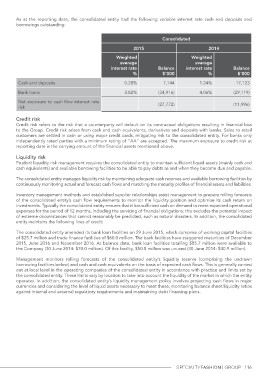
As at the reporting date, the consolidated entity had the following variable interest rate cash and deposits and
borrowings outstanding:

                                                              Consolidated

                                                        2015  Balance                  2014  Balance
                                                                $’000                          $’000
                                            Weighted                       Weighted           17,123
                                               average                        average
                                                                                             (29,119)
                                         interest rate                  interest rate
                                                       %                              %      (11,996)

Cash and deposits                                 0.28%       7,144         1.24%

Bank loans                                        3.82%       (34,916)      4.06%

Net exposure to cash flow interest rate                       (27,772)
risk

Credit risk
Credit risk refers to the risk that a counterparty will default on its contractual obligations resulting in financial loss
to the Group. Credit risk arises from cash and cash equivalents, derivatives and deposits with banks. Sales to retail
customers are settled in cash or using major credit cards, mitigating risk to the consolidated entity. For banks only
independently rated parties with a minimum rating of “AA” are accepted. The maximum exposure to credit risk at
reporting date is the carrying amount of the financial assets mentioned above.

Liquidity risk
Prudent liquidity risk management requires the consolidated entity to maintain sufficient liquid assets (mainly cash and
cash equivalents) and available borrowing facilities to be able to pay debts as and when they become due and payable.

The consolidated entity manages liquidity risk by maintaining adequate cash reserves and available borrowing facilities by
continuously monitoring actual and forecast cash flows and matching the maturity profiles of financial assets and liabilities.

Inventory management methods and established supplier relationships assist management to prepare rolling forecasts
of the consolidated entity’s cash flow requirements to monitor the liquidity position and optimise its cash return on
investments. Typically the consolidated entity ensures that it has sufficient cash on demand to meet expected operational
expenses for the period of 12 months, including the servicing of financial obligations; this excludes the potential impact
of extreme circumstances that cannot reasonably be predicted, such as natural disasters. In addition, the consolidated
entity maintains the following lines of credit:

The consolidated entity amended its bank loan facilities on 29 June 2015, which comprise of working capital facilities
of $25.7 million and trade finance facilities of $60.0 million. The bank facilities have staggered maturities of December
2015, June 2016 and November 2016. At balance date, bank loan facilities totalling $85.7 million were available to
the Company (30 June 2014: $70.0 million). Of this facility, $50.8 million was unused (30 June 2014: $40.9 million).

Management monitors rolling forecasts of the consolidated entity’s liquidity reserve (comprising the undrawn
borrowing facilities below) and cash and cash equivalents on the basis of expected cash flows. This is generally carried
out at local level in the operating companies of the consolidated entity in accordance with practice and limits set by
the consolidated entity. These limits vary by location to take into account the liquidity of the market in which the entity
operates. In addition, the consolidated entity’s liquidity management policy involves projecting cash flows in major
currencies and considering the level of liquid assets necessary to meet these, monitoring balance sheet liquidity ratios
against internal and external regulatory requirements and maintaining debt financing plans.

                                                                                             116

