


Page 21 - The Atlas of Economic Complexity
P. 21
22  |  THE ATLAS OF ECONOMIC COMPLEXITY


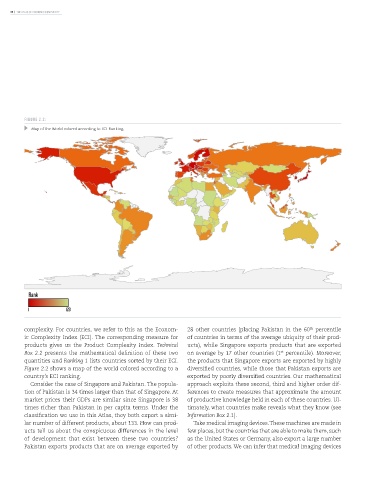
          FIGURE 2.2:

             Map of the World colored according to ECI Ranking.


            Rank

           1             128


                                                                                                                    th
          complexity. For countries, we refer to this as the Econom-   28  other  countries  (placing  Pakistan  in  the  60   percentile
          ic Complexity Index (ECI). The corresponding measure for     of countries in terms of the average ubiquity of their prod-
          products  gives  us  the  Product  Complexity  Index.  Technical   ucts),  while  Singapore  exports  products  that  are  exported
          Box 2.2 presents the mathematical definition of these two    on average by 17 other countries (1  percentile). Moreover,
                                                                                                         st
          quantities and Ranking 1 lists countries sorted by their ECI.   the products that Singapore exports are exported by highly
          Figure 2.2 shows a map of the world colored according to a   diversified countries, while those that Pakistan exports are
          country’s ECI ranking.                                       exported by poorly diversified countries. Our mathematical
            Consider the case of Singapore and Pakistan. The popula-   approach exploits these second, third and higher order dif-
          tion of Pakistan is 34 times larger than that of Singapore. At   ferences to create measures that approximate the amount
          market prices their GDPs are similar since Singapore is 38   of productive knowledge held in each of these countries. Ul-
          times richer than Pakistan in per capita terms. Under the    timately, what countries make reveals what they know (see
          classification we use in this Atlas, they both export a simi-  Information Box 2.1).
          lar number of different products, about 133. How can prod-     Take medical imaging devices. These machines are made in
          ucts tell us about the conspicuous differences in the level   few places, but the countries that are able to make them, such
          of  development  that  exist  between  these  two  countries?   as the United States or Germany, also export a large number
          Pakistan exports products that are on average exported by    of other products. We can infer that medical imaging devices

