


Page 24 - The Atlas of Economic Complexity
P. 24
MAPPING PATHS TO PROSPERITY  |  25


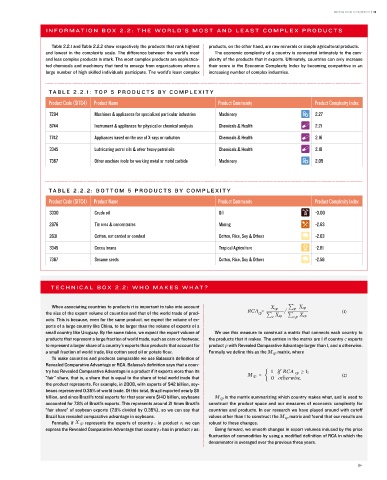
                  I n f o r m at I o n   B o x   2 . 2 :   t h e   w o r l d ’ s   m o s t   a n d   l e a s t   c o m p l e x   p r o d u c t s


                    table 2.2.1 and table 2.2.2 show respectively the products that rank highest   products, on the other hand, are raw minerals or simple agricultural products.
                  and lowest in the complexity scale. the difference between the world’s most   the economic complexity of a country is connected intimately to the com-
                  and less complex products is stark. the most complex products are sophistica-  plexity of the products that it exports. Ultimately, countries can only increase
                  ted chemicals and machinery that tend to emerge from organizations where a   their score in the economic Complexity index by becoming competitive in an
                  large number of high skilled individuals participate. the world’s least complex   increasing number of complex industries.


                   TA B L E   2 . 2 . 1 :   T O P   5   P R O D U C T S   B Y   C O M P L E X I T Y
                   Product Code (SITC4)  Product Name                             Product Community                   Product Complexity Index

                   7284             Machines & appliances for specialized particular industries  Machinery            2.27

                   8744             Instrument & appliances for physical or chemical analysis  Chemicals & Health     2.21
                   7742             Appliances based on the use of X-rays or radiation   Chemicals & Health           2.16

                   3345             Lubricating petrol oils & other heavy petrol oils  Chemicals & Health             2.10

                   7367             Other machine tools for working metal or metal carbide  Machinery                 2.05


                   TA B L E   2 . 2 . 2 :   B O T T O M   5   P R O D U C T S   B Y   C O M P L E X I T Y
                   Product Code (SITC4)  Product Name                             Product Community                   Product Complexity Index

                   3330             Crude oil                                     Oil                                 -3.00

                   2876             Tin ores & concentrates                       Mining                              -2.63
                   2631             Cotton, not carded or combed                  Cotton, Rice, Soy & Others          -2.63

                   3345             Cocoa beans                                   Tropical Agriculture                -2.61

                   7367             Sesame seeds                                  Cotton, Rice, Soy & Others          -2.58


                    t e c h n I c a l   B o x   2 . 2 :   w h o   m a k e s   w h at ?


                    When associating countries to products it is important to take into account
                  the size of the export volume of countries and that of the world trade of prod-
                  ucts. this is because, even for the same product, we expect the volume of ex-
                  ports of a large country like China, to be larger than the volume of exports of a
                  small country like Uruguay. By the same token, we expect the export volume of   We use this measure to construct a matrix that connects each country to
                  products that represent a large fraction of world trade, such as cars or footwear,   the products that it makes. the entries in the matrix are 1 if country   exports
                  to represent a larger share of a country’s exports than products that account for   product   with revealed Comparative advantage larger than 1, and o otherwise.
                  a small fraction of world trade, like cotton seed oil or potato flour.  Formally we define this as the    matrix, where
                    to make countries and products comparable we use Balassa’s definition of
                  revealed Comparative advantage or rCa. Balassa’s definition says that a coun-
                  try has revealed Comparative advantage in a product if it exports more than its
                  “fair” share, that is, a share that is equal to the share of total world trade that
                  the product represents. For example, in 2008, with exports of $42 billion, soy-
                  beans represented 0.35% of world trade. of this total, Brazil exported nearly $11
                  billion, and since Brazil’s total exports for that year were $140 billion, soybeans    is the matrix summarizing which country makes what, and is used to
                  accounted for 7.8% of Brazil’s exports. this represents around 21 times Brazil’s   construct the product space and our measures of economic complexity for
                  “fair share” of soybean exports (7.8% divided by 0.35%), so we can say that   countries and products. in our research we have played around with cutoff
                  Brazil has revealed comparative advantage in soybeans.       values other than 1 to construct the    matrix and found that our results are
                    Formally, if    represents the exports of country   in product  , we can   robust to these changes.
                  express the revealed Comparative advantage that country   has in product   as:   going forward, we smooth changes in export volumes induced by the price
                                                                               fluctuation of commodities by using a modified definition of rCa in which the
                                                                               denominator is averaged over the previous three years.

