


Page 23 - The Atlas of Economic Complexity
P. 23
24  |  THE ATLAS OF ECONOMIC COMPLEXITY


          T E CH N I C AL   B O X 2.1:   M E A SU R I N G E CONO M I C  COMPLE X I T Y:


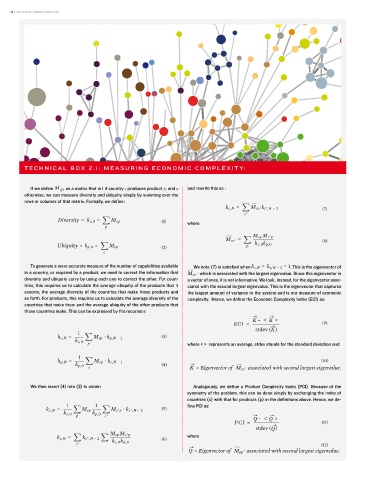
            If we define   , as a matrix that is 1 if country   produces product  , and   and rewrite this as :
          otherwise, we can measure diversity and ubiquity simply by summing over the
          rows or columns of that matrix. Formally, we define:


                                                                       where


            To generate a more accurate measure of the number of capabilities available   We note (7) is satisfied when    .This is the eigenvector of
          in a country, or required by a product, we need to correct the information that     which is associated with the largest eigenvalue. Since this eigenvector is
          diversity and ubiquity carry by using each one to correct the other. For coun-  a vector of ones, it is not informative. We look, instead, for the eigenvector asso-
          tries, this requires us to calculate the average ubiquity of the products that it   ciated with the second largest eigenvalue. This is the eigenvector that captures
          exports, the average diversity of the countries that make those products and   the largest amount of variance in the system and is our measure of economic
          so forth. For products, this requires us to calculate the average diversity of the   complexity.  Hence, we define the Economic Complexity Index (ECI) as:
          countries that make them and the average ubiquity of the other products that
          these countries make. This can be expressed by the recursion:


                                                                       where < >  represents an average, stdev stands for the standard deviation and


            We then insert (4) into (3) to obtain                        Analogously, we define a Product Complexity Index (PCI). Because of the
                                                                       symmetry of the problem, this can be done simply by exchanging the index of
                                                                       countries (c) with that for products (p) in the definitions above. Hence, we de-
                                                                       fine PCI as:


                                                                       where

