


Page 52 - The Atlas of Economic Complexity
P. 52
MAPPING PATHS TO PROSPERITY  |  53


                  t e c h n I c a l   B o x   5 . 3 :   I d e n t I f y I n g   p r o d u c t   c o m m u n I t I e s


                    in network science, groups of highly interconnected nodes are known as
                  communities. in the product space, communities represent groups of products
                  that are likely to require many of the same capabilities.
                    We assign products to communities using the algorithm introduced by ros-  FIGURE 5.3.1:
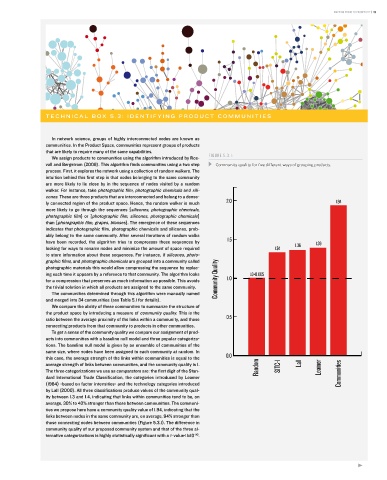
                  vall and Bergstrom (2008). this algorithm finds communities using a two step   Community quality for five different ways of grouping products.
                  process. First, it explores the network using a collection of random walkers. the
                  intuition behind this first step is that nodes belonging to the same community
                  are more likely to lie close by in the sequence of nodes visited by a random
                  walker. For instance, take photographic film, photographic chemicals and sili-
                  cones. these are three products that are interconnected and belong to a dense-
                  ly connected region of the product space. hence, the random walker is much   2.0                            1.94
                  more likely to go through the sequences {silicones, photographic chemicals,
                  photographic film}  or  {photographic film, silicones, photographic  chemicals}
                  than {photographic film, grapes, blouses}. the emergence of these sequences
                  indicates that photographic film, photographic chemicals and silicones, prob-
                  ably belong to the same community. after several iterations of random walks
                  have  been  recorded,  the  algorithm  tries  to  compresses  these  sequences  by   1.5     1.36    1.39
                  looking for ways to rename nodes and minimize the amount of space required           1.34
                  to store information about these sequences. For instance, if silicones, photo-
                  graphic films, and photographic chemicals are grouped into a community called
                  photographic materials this would allow compressing the sequence by replac-
                  ing each time it appears by a reference to that community. the algorithm looks   1.0+0.005
                  for a compression that preserves as much information as possible. this avoids   Community Quality  1.0
                  the trivial solution in which all products are assigned to the same community.
                    the communities determined through this algorithm were manually named
                  and merged into 34 communities (see table 5.1 for details).
                    We compare the ability of these communities to summarize the structure of
                  the product space by introducing a measure of community quality. this is the
                  ratio between the average proximity of the links within a community, and those   0.5
                  connecting products from that community to products in other communities.
                    to get a sense of the community quality we compare our assignment of prod-
                  ucts into communities with a baseline null model and three popular categoriza-
                  tions. the baseline null model is given by an ensemble of communities of the
                  same size, where nodes have been assigned to each community at random. in
                  this case, the average strength of the links within communities is equal to the   0.0
                  average strength of links between communities, and the community quality is 1.   Random  SITC-1  Lall  Leamer
                  the three categorizations we use as comparators are: the first digit of the stan-                             Communities
                  dard international trade Classification, the categories introduced by Leamer
                  (1984) -based on factor intensities- and the technology categories introduced
                  by Lall (2000). all three classifications produce values of the community qual-
                  ity between 1.3 and 1.4, indicating that links within communities tend to be, on
                  average, 30% to 40% stronger than those between communities. the communi-
                  ties we propose here have a community quality value of 1.94, indicating that the
                  links between nodes in the same community are, on average, 94% stronger than
                  those connecting nodes between communities (Figure 5.3.1). the difference in
                  community quality of our proposed community system and that of the three al-
                  ternative categorizations is highly statistically significant with a  -value<1x10 .
                                                                         -30

