


Page 47 - The Atlas of Economic Complexity
P. 47
48  |  THE ATLAS OF ECONOMIC COMPLEXITY


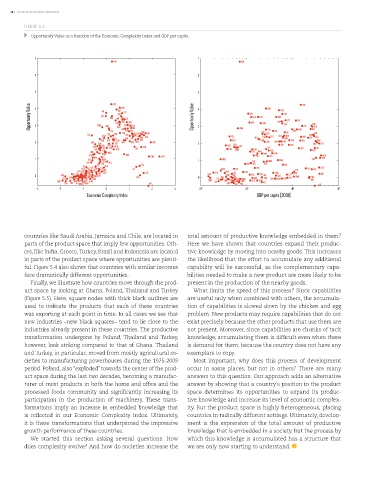
          FIGURE 5.4:
             Opportunity Value as a function of the Economic Complexity Index and GDP per capita.


              7                                                            7
                                           IND                                             IND

              6                                                            6


              5                            GRC                             5

            Opportunity Value  4       EGY  BRA  LVA TUR  BGR LTU EST CHN  Opportunity Value  4  IDN UKR SRB  EGY CHN  BGR  LBN TUR LTU EST  PRT  GRC  CAN
                                       IDN
                                             SRB
                                                                                                        BRA
                                            LBN PRT
                                              UKR
                                                                                                           LVA
                                     VNM
              3
                                        ARG
                                               ROU
                                          ZAF  CAN THA ESP  HRV NLD BEL  GBR  3           VNM     BIH  THA  ZAF  HR  ARG  ROU  ESP  BEL NLD
                                 TZA     COL  TUN  BIH POL  BLR HUN  FIN                            BLR             GBR  FIN
                                                   MEX
                                       GTM  NZL  PAN  ISR  KOR SGP                     TZA      ALB  TUN  COL  POL  HUN  KOR  ISR  SGP
                                                                                                           MEX
              2                    UGA  SEN KEN  ALB  CRI JOR  MYS  HKG  DNK  SVK  CHE  2  KEN SEN  GTM  JOR  MYS  CRI PAN  SVK  NZL  HKG  DNK CHE
                                    PAK  SYR KGZ  URY SLV  MDA  SVN                   UGA  PAK      SLV      URY
                                    AUS  LKA  RUS  IRL                                KGZ  MDA  SYR   RUS        SVN  AUS  IRL
                                   HND  MAR  MKD                                               LKA  MAR  MKD  DOM
                                  PER  MUS DOM  NOR      SWE  JPN                               HND  PER                 NOR
              1                   KAZ  MDG  NAM                            1        MDG                  MUS         SWE  JPN
                                 NIC   CHL GEO  PHL  USA                                     NIC  PHL  KAZ  NAM
                                                                                               GEO
                                CIV  PRY  ARE                                                              CHL
                               GHA  ETH UZB ZWE  TTO  ITA                          ZWE   CIV    PRY            TTO  ITA  ARE  USA
                                       JAM
                              DZA LBR  LAO  ECU  QAT SAU  CZE                    ETH  GHA  LAO  UZB    JAM    SAU
                                  BOL
              0         AG0  NGA  LBY MLI MOZ  BGD OMN  CUB                   LBR    MOZ  BGD  BOL  ECU  IRN  CUB  CZE  OMN  FRA  QAT
                                MWI
                        COG  GIN  GAB  YEM ZMB  BWA  FRA                   0      TCD  MLI  NGA YEM  MNG  AGO  DZA  GAB  BWA VEN  LBY
                                TJK
                      MRT   CMR TKM VEN  KHM                                   MWI  TJK  ZMB  GIN KHM  CMR  COG  TKM  AZE  KWT
                         SDN  PNG  AZE MNG IRN KWT      AUT                           MRT  SDN  PNG                    AUT
               -3      -2       -1      0        1       2        3        10 2             10 3             10 4             10 5
                                 Economic Complexity Index                                       GDP per capita [2008]
          countries like Saudi Arabia, Jamaica and Chile, are located in   total amount of productive knowledge embedded in them?
          parts of the product space that imply few opportunities. Oth-  Here  we  have  shown  that  countries  expand  their  produc-
          ers, like India, Greece, Turkey, Brazil and Indonesia are located   tive knowledge by moving into nearby goods. This increases
          in parts of the product space where opportunities are plenti-  the likelihood that the effort to accumulate any additional
          ful. Figure 5.4 also shows that countries with similar incomes   capability will be successful, as the complementary capa-
          face dramatically different opportunities.                   bilities needed to make a new product are more likely to be
            Finally, we illustrate how countries move through the prod-  present in the production of the nearby goods.
          uct space by looking at Ghana, Poland, Thailand and Turkey     What limits the speed of this process? Since capabilities
          (Figure 5.5). Here, square nodes with thick black outlines are   are useful only when combined with others, the accumula-
          used  to  indicate  the  products  that  each  of  these  countries   tion of capabilities is slowed down by the chicken and egg
          was exporting at each point in time. In all cases we see that   problem. New products may require capabilities that do not
          new industries –new black squares– tend to lie close to the   exist precisely because the other products that use them are
          industries already present in these countries. The productive   not present. Moreover, since capabilities are chunks of tacit
          transformation  undergone  by  Poland,  Thailand  and  Turkey,   knowledge, accumulating them is difficult even when there
          however, look striking compared to that of Ghana. Thailand   is demand for them, because the country does not have any
          and Turkey, in particular, moved from mostly agricultural so-  exemplars to copy.
          cieties to manufacturing powerhouses during the 1975-2009      Most  important,  why  does  this  process  of  development
          period. Poland, also “exploded” towards the center of the prod-  occur  in  some  places,  but  not  in  others? There  are  many
          uct space during the last two decades, becoming a manufac-   answers to this question. Our approach adds an alternative
          turer of most products in both the home and office and the   answer by showing that a country’s position in the product
          processed  foods  community  and  significantly  increasing  its   space  determines  its  opportunities  to  expand  its  produc-
          participation  in  the  production  of  machinery.  These  trans-  tive knowledge and increase its level of economic complex-
          formations imply an increase in embedded knowledge that      ity. But the product space is highly heterogeneous, placing
          is  reflected  in  our  Economic  Complexity  Index.  Ultimately,   countries in radically different settings. Ultimately, develop-
          it is these transformations that underpinned the impressive   ment  is  the  expression  of  the  total  amount  of  productive
          growth performance of these countries.                       knowledge that is embedded in a society. But the process by
            We  started  this  section  asking  several  questions:  How   which this knowledge is accumulated has a structure that
          does complexity evolve? And how do societies increase the    we are only now starting to understand.

