


Page 51 - The Atlas of Economic Complexity
P. 51
52  |  THE ATLAS OF ECONOMIC COMPLEXITY


          t e c h n I c a l   B o x   5 . 1 :   m e a s u r I n g   p r o x I m I t y


            to make products you need chunks of embedded knowledge which we call   stringent. For instance, in the year 2008, 17 countries exported wine, 24 ex-
          capabilities. the capabilities needed to produce one good may or may not be   ported grapes and 11 exported both, all with rCa>1. then, the proximity between
          useful in the production of other goods. since we do not observe capabilities   wines and grapes is 11/24=0.46. note that we divide by 24 instead of 17 to mini-
          directly, we create a measure that infers the similarity between the capabili-  mize false positives. Formally, for a pair of goods   and   we define proximity as:
          ties required by a pair of goods by looking at the probability that they are co-
          exported. to quantify this similarity we assume that if two goods share most
          of the requisite capabilities, the countries that export one will also export the
          other. By the same token, goods that do not share many capabilities are less
          likely to be co-exported.
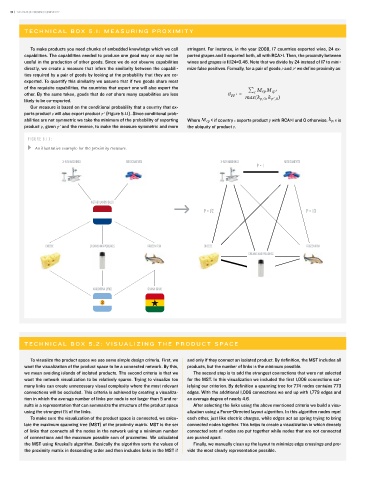
            our measure is based on the conditional probability that a country that ex-
          ports product   will also export product   (Figure 5.1.1). since conditional prob-
          abilities are not symmetric we take the minimum of the probability of exporting   Where    =1 if country   exports product   with rCa>1 and 0 otherwise.    is
          product  , given   and the reverse, to make the measure symmetric and more   the ubiquity of product  .

           FIGURE 5.1.1:
              An illustrative example for the proximity measure.

                        X-RAY MACHINES          MEDICAMENTS                        X-RAY MACHINES          MEDICAMENTS
                                                                                                 P  =  1


                                   NETHERLANDS (NLD)
                                                                             P  =  1/2                             P  =  1/3


                  CHEESE          CREAMS AND POLISHES   FROZEN FISH          CHEESE                                FROZEN FISH
                                                                                              CREAMS AND POLISHES


                                    ARGENTINA (ARG)     GHANA (GHA)


          t e c h n I c a l   B o x   5 . 2 :   v I s u a l I z I n g   t h e   p r o d u c t   s pa c e


            to visualize the product space we use some simple design criteria. First, we   and only if they connect an isolated product. By definition, the Mst includes all
          want the visualization of the product space to be a connected network. By this,   products, but the number of links is the minimum possible.
          we mean avoiding islands of isolated products. the second criteria is that we   the second step is to add the strongest connections that were not selected
          want the network visualization to be relatively sparse. trying to visualize too   for the Mst. in this visualization we included the first 1,006 connections sat-
          many links can create unnecessary visual complexity where the most relevant   isfying our criterion. By definition a spanning tree for 774 nodes contains 773
          connections will be occluded. this criteria is achieved by creating a visualiza-  edges. With the additional 1,006 connections we end up with 1,779 edges and
          tion in which the average number of links per node is not larger than 5 and re-  an average degree of nearly 4.6.
          sults in a representation that can summarize the structure of the product space   after selecting the links using the above mentioned criteria we build a visu-
          using the strongest 1% of the links.                         alization using a Force-Directed layout algorithm. in this algorithm nodes repel
            to make sure the visualization of the product space is connected, we calcu-  each other, just like electric charges, while edges act as spring trying to bring
          late the maximum spanning tree (Mst) of the proximity matrix. Mst is the set   connected nodes together. this helps to create a visualization in which densely
          of links that connects all the nodes in the network using a minimum number   connected sets of nodes are put together while nodes that are not connected
          of connections and the maximum possible sum of proximities. We calculated   are pushed apart.
          the Mst using Kruskal’s algorithm. Basically the algorithm sorts the values of   Finally, we manually clean up the layout to minimize edge crossings and pro-
          the proximity matrix in descending order and then includes links in the Mst if   vide the most clearly representation possible.

