


Page 143 - DK Children's Encyclopedia
P. 143
Jupiter                                                                           SEE ALSO

                                                                                               ▸ ▸ Astronomy  p.32
                                                                                               ▸ ▸ Atmosphere  p.33
           Jupiter is the largest planet in the solar system, and                              ▸ ▸ Elements  p.90
           the fifth planet from the sun. It is a “gas giant” made                             ▸ ▸ Gases  p.117
           of hydrogen and helium. Jupiter does not have a                                    ▸ ▸ Solar system  p.233

           solid surface like Earth.                                                           ▸ ▸ Solids  p.234

                                                                                               ▸ ▸ Storms  p.246


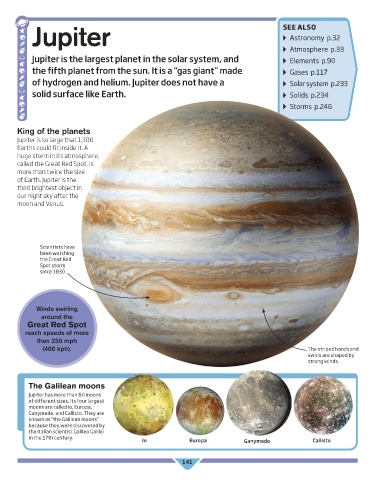
       King of the planets
       Jupiter is so large that 1,300
       Earths could fit inside it. A
       huge storm in its atmosphere,
       called the Great Red Spot, is
       more than twice the size
       of Earth. Jupiter is the
       third brightest object in
       our night sky after the
       moon and Venus.


              Scientists have
              been watching
              the Great Red
              Spot storm
              since 1830.


             Winds swirling
              around the
          Great Red Spot
         reach speeds of more
             than 250 mph
               (400 kph).                                                                             The striped bands and
                                                                                                      swirls are shaped by
                                                                                                      strong winds.


          The Galilean moons
          Jupiter has more than 60 moons
          of different sizes. Its four largest
          moons are called Io, Europa,
          Ganymede, and Callisto. They are
          known as “the Galilean moons”
          because they were discovered by
          the Italian scientist Galileo Galilei
          in the 17th century.                 Io              Europa            Ganymede              Callisto


                                                             141


   US_141_Jupiter.indd   141                                                                                     16/05/2017   09:48

