


Page 145 - DK Children's Encyclopedia
P. 145
Lakes                                                                             SEE ALSO

                                                                                               ▸ ▸ Climate change
                                                                                                p.60

           A lake is a large body of water surrounded by land.                                 ▸ ▸ Factories  p.97
           Most lakes contain fresh water, but some are salty.                                 ▸ ▸ Farming  p.98
           Lakes are usually found in high areas or near large                                ▸ ▸ Water  pp.120–121

           rivers. The water in lakes comes from streams or                                    ▸ ▸ Rivers  p.211
           rivers around them.                                                                 ▸ ▸ Water cycle
                                                                                                p.270


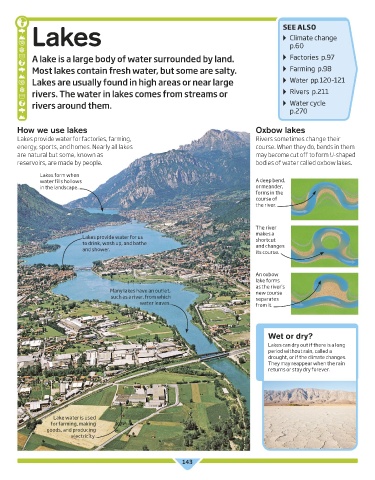
       How we use lakes                                                              Oxbow lakes
       Lakes provide water for factories, farming,                                   Rivers sometimes change their
       energy, sports, and homes. Nearly all lakes                                   course. When they do, bends in them
       are natural but some, known as                                                may become cut off to form U-shaped
       reservoirs, are made by people.                                               bodies of water called oxbow lakes.

              Lakes form when
              water fills hollows                                                    A deep bend,
              in the landscape.                                                      or meander,
                                                                                     forms in the
                                                                                     course of
                                                                                     the river.


                                                                                     The river
                                                                                     makes a
                            Lakes provide water for us                               shortcut
                            to drink, wash up, and bathe                             and changes
                            and shower.
                                                                                     its course.


                                                                                     An oxbow
                                                                                     lake forms
                                                                                     as the river’s
                                     Many lakes have an outlet,                      new course
                                     such as a river, from which                     separates
                                               water leaves.                         from it.


                                                                                         Wet or dry?
                                                                                         Lakes can dry out if there is a long
                                                                                         period without rain, called a
                                                                                         drought, or if the climate changes.
                                                                                         They may reappear when the rain
                                                                                         returns or stay dry forever.


                  Lake water is used
                  for farming, making
                goods, and producing
                        electricity.


                                                             143


   US_143_Lakes.indd   143                                                                                       16/05/2017   09:48

