


Page 229 - DK Children's Encyclopedia
P. 229
Sinking and floating                                                              SEE ALSO

                                                                                               ▸ ▸ Forces  p.108
                                                                                               ▸ ▸ Gases  p.117
           When we place objects in water they can float on the                                ▸ ▸ Gravity  p.125
           surface or sink below it. The heavier and more packed                               ▸ ▸ Materials  p.157
           together a material is, the more likely it is to sink. Materials                    ▸ ▸ Metals  p.162

           like stone and metal usually sink, while wood and plastics                          ▸ ▸ Ships  p.224
           usually float.


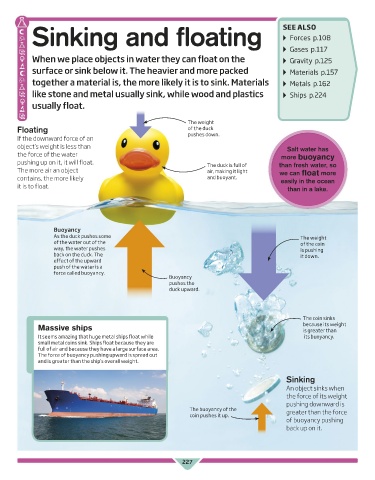
                                                              The weight
       Floating                                               of the duck
       If the downward force of an                            pushes down.
       object’s weight is less than                                                            Salt water has
       the force of the water                                                                more buoyancy
       pushing up on it, it will float.                              The duck is full of    than fresh water, so
       The more air an object                                        air, making it light   we can float more
       contains, the more likely                                     and buoyant.            easily in the ocean
       it is to float.                                                                         than in a lake.


                   Buoyancy
                   As the duck pushes some                                                         The weight
                   of the water out of the                                                         of the coin
                   way, the water pushes                                                           is pushing
                   back on the duck. The                                                           it down.
                   effect of the upward
                   push of the water is a
                   force called buoyancy.
                                                        Buoyancy
                                                        pushes the
                                                        duck upward.


                                                                                                    The coin sinks
             Massive ships                                                                          because its weight
                                                                                                    is greater than
             It seems amazing that huge metal ships float while                                      its buoyancy.
             small metal coins sink. Ships float because they are
             full of air and because they have a large surface area.
             The force of buoyancy pushing upward is spread out
             and is greater than the ship’s overall weight.

                                                                                               Sinking
                                                                                               An object sinks when
                                                                                               the force of its weight
                                                                                               pushing downward is
                                                               The buoyancy of the             greater than the force
                                                               coin pushes it up.
                                                                                               of buoyancy pushing
                                                                                               back up on it.


                                                             227


   US_227_Sinking_and_floating.indd   227                                                                        16/05/2017   12:11

