


Page 21 - St Giles Catesby booklet MC StG 20210723 e-flip_Neat
P. 21
American green tree frog
           Mark Catesby seems to have been intrigued by this "bright grass Green"
           tree frog that does indeed inhabit trees. "They appear seldom in the Day",
           he wrote, "but at Night are very active and noisy, leaping from Spray to
           Spray,  on  the  tallest  Trees,  catching  Fire  Flies  and  other  Insects,
           incessantly chirping chit chit chit chit." He may even have kept one of these
           small frogs as a pet for he described holding one four yards (4m) away
           from  a  reclining  mirror  on  to  which  the  frog  leapt  and  stuck  fast.  He
           noticed that in the wild they were usually to be found on the undersides
           of leaves "to conceal themselves from their ... Enemies" such as birds and
           snakes. They "stick" to leaves using the enlarged sticky pads at the ends
           of their toes. Catesby's description of the pads was evocative: "they being
           round,  fleshy,  and  concave,  somewhat  like  the  Mouth  of  a  Leech."
           Catesby,  perhaps  having  fun  (one  of  his  traits),  drew  the  tree  frog
           seemingly eyeing a large spider, a green lynx spider (Peucetia viridans), that
           is dangling on its silken thread above.
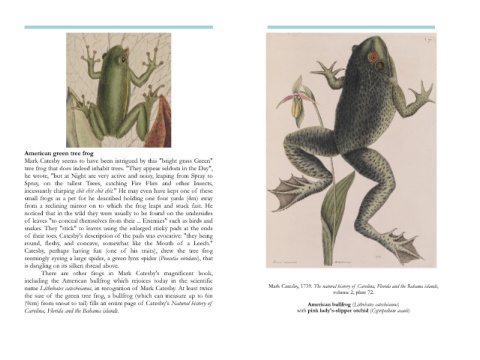
                   There  are  other  frogs  in  Mark  Catesby's  magnificent  book,
           including  the  American  bullfrog  which  rejoices  today  in  the  scientific
           name Lithobates catesbeianus, in recognition of Mark Catesby. At least twice                             Mark Catesby, 1739. The natural history of  Carolina, Florida and the Bahama islands,
           the size of the green tree frog, a bullfrog (which can measure up to 6in                                                            volume 2, plate 72.
           (9cm) from snout to tail) fills an entire page of Catesby's Natural history of                                           American bullfrog (Lithobates catesbeianus)
           Carolina, Florida and the Bahama islands.                                                                            with pink lady's-slipper orchid (Cypripedium acaule)

