


Page 19 - St Giles Catesby booklet MC StG 20210723 e-flip_Neat
P. 19
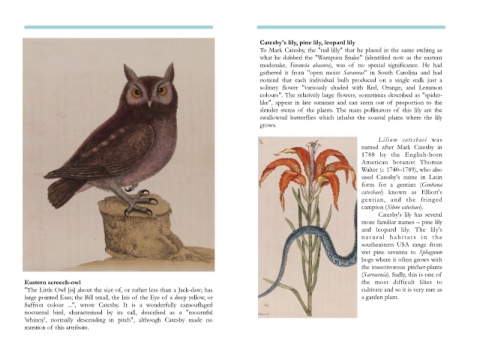
Catesby's lily, pine lily, leopard lily
                                                                                                                To Mark Catesby, the "red lilly" that he placed in the same etching as
                                                                                                                what he dubbed the "Wampum Snake" (identified now as the eastern
                                                                                                                mudsnake,  Farancia  abacura),  was  of  no  special  significance.  He  had
                                                                                                                gathered  it  from  "open  moist  Savannas"  in  South  Carolina  and  had
                                                                                                                noticed  that  each  individual  bulb  produced  on  a  single  stalk  just  a
                                                                                                                solitary  flower  "variously  shaded  with  Red,  Orange,  and  Lemmon
                                                                                                                colours". The relatively large flowers, sometimes described as "spider-
                                                                                                                like", appear in late summer and can seem out of proportion to the
                                                                                                                slender stems of the plants. The main pollinators of this lily are the
                                                                                                                swallowtail  butterflies  which  inhabit  the  coastal  plains  where  the  lily
                                                                                                                grows.


                                                                                                                                                                  Lilium  catesbaei was
                                                                                                                                                           named  after  Mark  Catesby  in
                                                                                                                                                           1788  by  the  English-born
                                                                                                                                                           American  botanist  Thomas
                                                                                                                                                           Walter (c. 1740–1789), who also
                                                                                                                                                           used  Catesby's  name  in  Latin
                                                                                                                                                           form  for  a  gentian  (Gentiana
                                                                                                                                                           catesbaei)  known  as  Elliott's
                                                                                                                                                           gentian,  and  the  fringed
                                                                                                                                                           campion (Silene catesbaei).
                                                                                                                                                                  Catesby's lily has several
                                                                                                                                                           more familiar names – pine lily
                                                                                                                                                           and  leopard  lily.  The  lily's
                                                                                                                                                           natural  habitats  in  the
                                                                                                                                                           southeastern  USA  range  from
                                                                                                                                                           wet  pine  savanna  to  Sphagnum
                                                                                                                                                           bogs where it often grows with
                                                                                                                                                           the insectivorous pitcher-plants
                                                                                                                                                           (Sarracenia). Sadly, this is one of
           Eastern screech-owl                                                                                                                             the  most  difficult  lilies  to
           "The Little Owl [is] about the size of, or rather less than a Jack-daw; has                                                                     cultivate and so it is very rare as
           large pointed Ears; the Bill small, the Iris of the Eye of a deep yellow, or                                                                    a garden plant.
           Saffron  colour  ...",  wrote  Catesby.  It  is  a  wonderfully  camouflaged
           nocturnal  bird,  characterized  by  its  call,  described  as  a  "mournful
           'whinny',  normally  descending  in  pitch",  although  Catesby  made  no
           mention of this attribute.

