


Page 22 - St Giles Catesby booklet MC StG 20210723 e-flip_Neat
P. 22
Rice
Rice is not a native crop in North
America but was brought to the
continent by the enslaved West
African peoples who were skilled in
its cultivation and had distinctive
methods for preparing and cooking
the grain. By Catesby's time, rice was
much cultivated in the South Carolina
Lowcountry close to the Atlantic
coast, and had become an important
cash-crop and export commodity.
Remarkably, Catesby's account
of rice entails the story of the
ricebird (now known as the
bobolink), an American migratory
species, huge flocks of which
descended on the ripening crop
destroying vast acreages: "In the
beginning of September, while the
Grain of Rice is yet soft and milky,
innumerable Flights of these Birds
arrive from some remote Parts ... [and
in] 1724 an Inhabitant near Ashley
River had forty acres of Rice so
devoured by them ...". The ricebird
gave Catesby "food for thought" and
led to him developing the novel
theory about "birds of passage" –
birds which migrate seasonally – that
he presented to the Royal Society of
London in 1747.
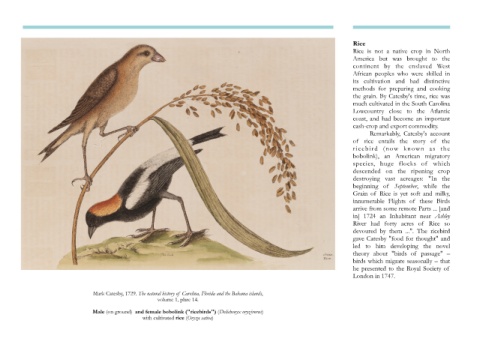
Mark Catesby, 1729. The natural history of Carolina, Florida and the Bahama islands,
volume 1, plate 14.
Male (on ground) and female bobolink ("ricebirds") (Dolichonyx oryzivorus)
with cultivated rice (Oryza sativa)

