


Page 110 - Basic Course
P. 110
KNX BASIC COURSE

                  14  The prevention of loops

                                              230 V AC


                                                                                        Bonding Bar


                         Power                                       Power
                         supply                                      supply                         Water pipe


                                Bus                                          Bus
                                          DVC                                          DVC


                                                               Loop between bus – water supply system
                          Loop between bus – 230 V AC
                                                                 consisting of DVC, power supply and
                      Consisting of DVC and power supply
                                                                              bonding bar

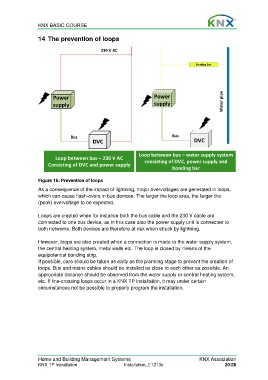
                  Figure 16: Prevention of loops

                  As a consequence of the impact of lightning, major overvoltages are generated in loops,
                  which can cause flash-overs in bus devices. The larger the loop area, the larger the
                  (peak) overvoltage to be expected.

                  Loops are created when for instance both the bus cable and the 230 V cable are
                  connected to one bus device, as in this case also the power supply unit is connected to
                  both networks. Both devices are therefore at risk when struck by lightning.

                  However, loops are also created when a connection is made to the water supply system,
                  the central heating system, metal walls etc. The loop is closed by means of the
                  equipotential bonding strip.
                  If possible, care should be taken as early as the planning stage to prevent the creation of
                  loops. Bus and mains cables should be installed as close to each other as possible. An
                  appropriate distance should be observed from the water supply or central heating system,
                  etc. If line-crossing loops occur in a KNX TP installation, it may under certain
                  circumstances not be possible to properly program the installation.


                  Home and Building Management Systems                                   KNX Association
                  KNX TP Installation                   Installation_E1213c                          20/28

