


Page 163 - Advanced Course
P. 163
KNX ADVANCED COURSE


                  1  General

                  The lighting in modern buildings is generally no longer switched manually. The users in
                  principle demand the implementation of intelligent open- and closed-loop lighting control
                  systems. This should result in the efficient operation of the lighting. Efficiency has three
                  meanings in this context: firstly, there should be an obvious saving of energy; secondly,
                  intelligent lighting systems should largely prevent lights from being switched on
                  unnecessarily which should lead finally to an automatic protection of resources!


                  2  Conventional Brightness Control: Sun shines – Light switches

                      off

                  If dimmed fluorescent lamps are used for example instead of switched lamps, the service
                  life of the fluorescent material is lengthened considerably even when the maximum power
                  is reduced by only 10%. This again results in cost savings and protection of the
                  environment. A well-designed lighting control system also means a more pleasant working
                  environment for the user e.g. from office workstations. It is also worth mentioning in this
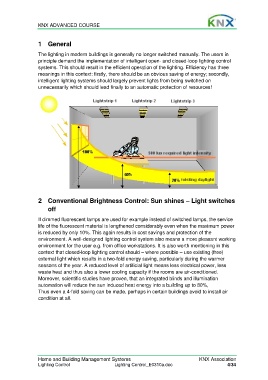
                  context that closed-loop lighting control should – where possible – use existing (free)
                  external light which results in a two-fold energy saving, particularly during the warmer
                  seasons of the year. A reduced level of artificial light means less electrical power, less
                  waste heat and thus also a lower cooling capacity if the rooms are air-conditioned.
                  Moreover, scientific studies have proven, that an integrated blinds and illumination
                  automation will reduce the sun induced heat energy into a building up to 80%,
                  Thus even a 4-fold saving can be made, perhaps in certain buildings avoid to install air
                  condition at all.


                  Home and Building Management Systems                                    KNX Association
                  Lighting Control                  Lighting Control_E0310a.doc                       4/34

