


Page 164 - Advanced Course
P. 164
KNX ADVANCED COURSE


                                         Light strip 1    Light strip 2     Light strip 3


                                             ~ 26 %          ~ 48 %           ~ 70 %
                                                   Receiver          Receiver         Receiver


                                                                 500 lux required light intensity

                                                                               Necessary
                                                                               artificial light

                                                                               Existing daylight


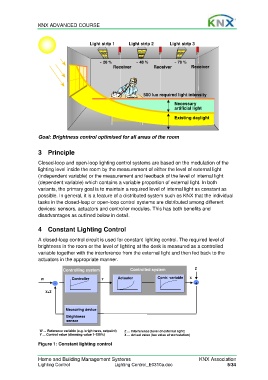
                  Goal: Brightness control optimised for all areas of the room


                  3  Principle

                  Closed-loop and open-loop lighting control systems are based on the modulation of the
                  lighting level inside the room by the measurement of either the level of external light
                  (independent variable) or the measurement and feedback of the level of internal light
                  (dependent variable) which contains a variable proportion of external light. In both
                  variants, the primary goal is to maintain a required level of internal light as constant as
                  possible. In general, it is a feature of a distributed system such as KNX that the individual
                  tasks in the closed-loop or open-loop control systems are distributed among different
                  devices: sensors, actuators and controller modules. This has both benefits and
                  disadvantages as outlined below in detail.

                  4  Constant Lighting Control

                  A closed-loop control circuit is used for constant lighting control. The required level of
                  brightness in the room or the level of lighting at the desk is measured as a controlled
                  variable together with the interference from the external light and then fed back to the
                  actuators in the appropriate manner.

                             Controlling system            Controlled system            Z

                   W             Controller   Y      Actuator           Contr. variable  X
                         -                                                             +
                     X+Z


                              Measuring device
                              Brightness
                              sensor

                   W ... Reference variable (e.g. brightness, setpoint)  Z ... Interference (level of external light)
                   Y ... Control value (dimming value 1-100%)  X ... Actual value (lux value at workstation)
                  Figure 1: Constant lighting control


                  Home and Building Management Systems                                    KNX Association
                  Lighting Control                  Lighting Control_E0310a.doc                       5/34

