


Page 169 - Advanced Course
P. 169
KNX ADVANCED COURSE

                  of the actuator and dimming step width and send interval of the controller should match
                  precisely:
                  If e.g. 1/64 dimming telegrams are sent every 2 seconds, the dimmer must be set so that
                  it makes a full cycle of 0 – 100% in 128 sec and no faster.
                  If it should also be possible to operate the dimmer manually, a shorter dimming period is
                  of course required. Differences can therefore be found in this regard between the
                  available devices as not all of them offer this possibility (see the note in the next section).


                  4.5  Parameterisation Notes, Flags, Possible Errors, Bus Load etc.

                  The previously named condition (dimming period of 128 sec) is optimised for the control
                  system but not for manual operation. A compromise must often be made: the actuator
                  dims at a slightly slower rate e.g. in 8 sec and the controller transmits at a slightly faster
                  rate to avoid stepwise brightness processes. This increases the bus load however.
                  Alternatively 1/32 is used as a step width instead of 1/64 to reduce the bus load again.
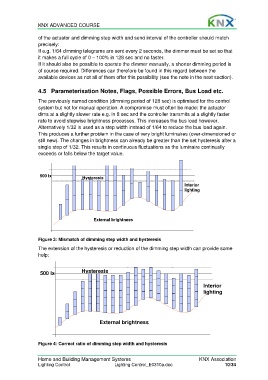
                  This produces a further problem in the case of very bright luminaires (over-dimensioned or
                  still new). The changes in brightness can already be greater than the set hysteresis after a
                  single step of 1/32. This results in continuous fluctuations as the luminaire continually
                  exceeds or falls below the target value.


                   500 lx             Hysteresis
                                                                                   Interior
                                                                                   lighting


                                           External brightness


                  Figure 3: Mismatch of dimming step width and hysteresis

                  The extension of the hysteresis or reduction of the dimming step width can provide some
                  help:


                   500 lx            Hysteresis

                                                                                           Interior
                                                                                           lighting


                                             External brightness


                  Figure 4: Correct ratio of dimming step width and hysteresis


                  Home and Building Management Systems                                    KNX Association
                  Lighting Control                  Lighting Control_E0310a.doc                      10/34

