


Page 213 - Advanced Course
P. 213
KNX ADVANCED COURSE

                  3.5  Panic Alarms
                  Panic alarms are push buttons which are operated should someone find themselves in
                  danger. A remote alarm is activated immediately after operation of the push button. A
                  panic alarm may then only trigger a local alarm if the transmission route of the remote
                  alarm is disrupted.
                  A further possibility is a silent alarm at an alarm receiving office (security staff).


                  3.6  Monitoring


                  3.6.1  Opening Surveillance, Lock Monitoring
                  The monitoring of windows, doors, skylights or similar to detect if they are opened or
                  closed is called opening surveillance. The locked or bolted status of doors, windows or
                  skylights is observed using lock monitoring. A disruption in a lock monitoring circuit or
                  zone does not lead to an alarm but prevents the system from being set.
                  To achieve the enforced contact separation when setting an intruder alarm system, the
                  lock state of doors, gates and windows must be monitored. An unlocked component
                  prevents the intruder alarm system from being armed. In “set” mode, a fault in the lock
                  monitoring does not lead to an alarm being sent.

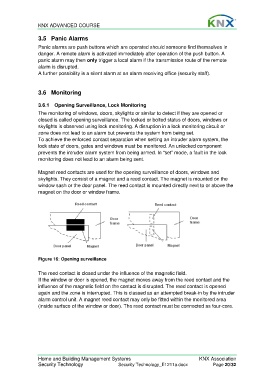
                  Magnet reed contacts are used for the opening surveillance of doors, windows and
                  skylights. They consist of a magnet and a reed contact. The magnet is mounted on the
                  window sash or the door panel. The reed contact is mounted directly next to or above the
                  magnet on the door or window frame.


                  Figure 16: Opening surveillance

                  The reed contact is closed under the influence of the magnetic field.
                  If the window or door is opened, the magnet moves away from the reed contact and the
                  influence of the magnetic field on the contact is disrupted. The reed contact is opened
                  again and the zone is interrupted. This is classed as an attempted break-in by the intruder
                  alarm control unit. A magnet reed contact may only be fitted within the monitored area
                  (inside surface of the window or door). The reed contact must be connected as four-core.


                  Home and Building Management Systems                                    KNX Association
                  Security Technology                 Security Technology_E1211a.docx           Page 20/32

