


Page 279 - Advanced Course
P. 279
KNX ADVANCED COURSE

                  1  General


                  1.1  Foreword

                      Multimedia  technology has rapidly developed  over the last years, and multimedia
                      systems have improved to such a level that they can offer excellent quality of audio or
                      video to all sectors of daily life. Many residential buildings have an intercom system to
                      enable inhabitants to communicate with others inside or outside of the building, e.g. a
                      door phone system.
                      Moreover,  commercial  buildings  include  video  and/or  audio  applications  in  order  to
                      provide to visitors useful information, e.g. airports have screens in order to provide
                      information about flights, but they also use speakers to announce any flight incidents.
                      So, it is obvious that multimedia systems are nowadays becoming an integral part of
                      building  systems,  and  they thus should be controllable  via the installed Building
                      Management System.

                  1.2  Definitions of multimedia and multimedia system

                      The term ‘multimedia’ describes a medium that contains several content formats. It
                      can include a combination of audio, video, still images, text or even animation.
                      Moreover,  a  ‘multimedia system’  is defined by  a combination of several multimedia
                      components that constitute a functional system, which in most cases can record, play,
                      or even display the multimedia content.

                  2  Types of multimedia systems


                  2.1  Audio systems

                      An  audio  system  generally  consists  of electronic equipment for recording or
                      reproducing sound. In order to be clear, we are going to distinguish audio systems in
                      two categories. These are: ‘Typical audio system’ and ‘Extended audio system’.

                  2.1.1  Typical audio system

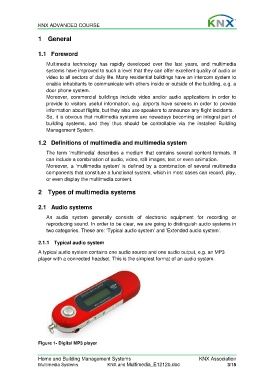
                  A typical audio system contains one audio source and one audio output, e.g. an MP3
                  player with a connected headset. This is the simplest format of an audio system.


                  Figure 1- Digital MP3 player


                  Home and Building Management Systems                                   KNX Association
                  Multimedia Systems             KNX and Multimedia_E1212b.doc                        3/15

