


Page 68 - Advanced Course
P. 68
KNX ADVANCED COURSE


                  3.2  KNX Integration

                  As fan coil units usually do not have an integrated KNX interface, each unit requires a fan
                  coil actuator for activation. These actuators have different connection options which
                  enable the individual components to be linked.
                  This includes e.g. the triggering of the fan which can be switched on at different speeds
                  and the speed can also be increased. In this case, the actuator can adopt the function of a
                  conventional step switch. Alternatively, several actuators have the option of activating the
                  fan continuously.

                  The fan(s) can also be electrothermal or electromotive. They can be triggered via 2-step
                  control or via switching or continuous PI control. The majority of actuators have a further
                  load contact as mentioned in the 2-pipe variant which enables an electric booster heater
                  to be connected. Binary inputs are also integrated in the actuator to monitor the
                  condensate tray or to query a window contact for example.

                  If the room thermostat establishes that the current measured temperature in the room is
                  too high or too low based on its setpoint temperature, it sends a command to the fan coil
                  unit. The fan coil actuator then decides how the required valve is moved (opened or
                  closed) based on the telegram/sent control value and at which speed the fan is switched.


                  3.2.1  Fans


                  The speed control of the connected fan can be set in two different ways in the parameters
                  depending on its technical design.
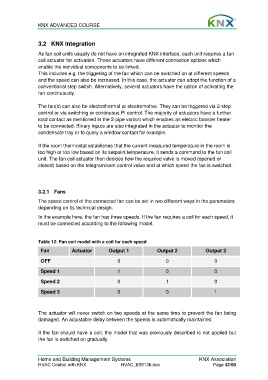
                  In the example here, the fan has three speeds. If the fan requires a coil for each speed, it
                  must be connected according to the following model.


                  Table 12: Fan coil model with a coil for each speed
                   Fan           Actuator        Output 1              Output 2             Output 3

                   OFF                               0                     0                    0

                   Speed 1                           1                     0                    0

                   Speed 2                           0                     1                    0

                   Speed 3                           0                     0                    1


                  The actuator will never switch on two speeds at the same time to prevent the fan being
                  damaged. An adjustable delay between the speeds is automatically maintained.

                  If the fan should have a coil, the model that was previously described is not applied but
                  the fan is switched on gradually.


                  Home and Building Management Systems                                    KNX Association
                  HVAC Control with KNX                HVAC_E0813b.doc                          Page 42/60

