


Page 71 - Advanced Course
P. 71
KNX ADVANCED COURSE

                  4.3  Integration in KNX
                  As it is often the case in the world of KNX, the market offers different integration
                  approaches. The model and make of the air conditioner are decisive here. Either the air
                  conditioner communicates via a proprietary protocol or via a common interoperable
                  automation standard: this will determine the layout of the gateway towards KNX. A further
                  differentiating factor is the type of communication. This can either be unidirectional or
                  bidirectional.


                  4.3.1  Proprietary Protocol

                  In case the air conditioner is equipped with a proprietary interface (depending on make),
                  the integration will be done via a purpose built gateway. This will be necessary because
                  the structure of the telegram and its message is not published and consequently is not
                  available. Without this background information it will be very difficult or even impossible to
                  realize the integration. The gateway is therefore shipped with an application including
                  communication objects, parameter settings, etc.


                  4.3.2  Gateway to an open Automation Protocol


                  Should the air conditioner, however, be equipped with an open standard (i.e. BACnet)
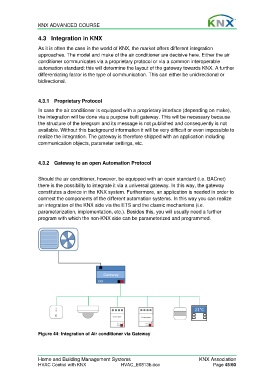
                  there is the possibility to integrate it via a universal gateway. In this way, the gateway
                  constitutes a device in the KNX system. Furthermore, an application is needed in order to
                  connect the components of the different automation systems. In this way you can realize
                  an integration of the KNX side via the ETS and the classic mechanisms (i.e.
                  parameterization, implementation, etc.). Besides this, you will usually need a further
                  program with which the non-KNX side can be parameterized and programmed.


                  Figure 44: Integration of Air conditioner via Gateway


                  Home and Building Management Systems                                    KNX Association
                  HVAC Control with KNX                HVAC_E0813b.doc                          Page 45/60

