


Page 70 - Advanced Course
P. 70
KNX ADVANCED COURSE


                  4  Integrating air conditioning systems


                  4.1  Introduction


                  Because of the use of KNX across different applications and its high level of integration,
                  one needs to certainly also familiarize oneself with the connection of air conditioners to
                  KNX systems. This is especially relevant in climate zones where temperatures are higher
                  and heating is less of an issue. However, the need for air conditioning may also arise in
                  glass buildings, where room temperatures can increase significantly during the summer.
                  In buildings that house both heating and air conditioning systems, you often find that these
                  systems are managed separately, sometimes even by different people. In order to avoid
                  conflicting approaches in such a situation, it is highly useful to integrate all components
                  into a KNX system. By doing so, you can avoid that the air conditioning system cools
                  while the heating at the same time tries to keep the temperature level constant by
                  simultaneously heating the room.


                  4.2  Technical Design
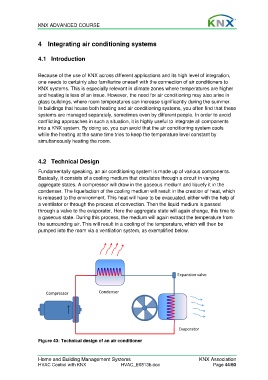
                  Fundamentally speaking, an air conditioning system is made up of various components.
                  Basically, it consists of a cooling medium that circulates through a circuit in varying
                  aggregate states. A compressor will draw in the gaseous medium and liquefy it in the
                  condenser. The liquefaction of the cooling medium will result in the creation of heat, which
                  is released to the environment. This heat will have to be evacuated, either with the help of
                  a ventilator or through the process of convection. Then the liquid medium is passed
                  through a valve to the evaporator. Here the aggregate state will again change, this time to
                  a gaseous state. During this process, the medium will again extract the temperature from
                  the surrounding air. This will result in a cooling of the temperature, which will then be
                  pumped into the room via a ventilation system, as exemplified below.


                  Figure 43: Technical design of an air conditioner

                  Home and Building Management Systems                                    KNX Association
                  HVAC Control with KNX                HVAC_E0813b.doc                          Page 44/60

