


Page 118 - Digital Electronics by harish
P. 118
4.11  EPROM (Erasable Programmable Read Only Memory)

                       EPROM (Erasable Programmable Read Only Memory) is a type of memory chip. It
               retains  its  data  even  when  the  power  supply  is  switched  off.    So,  it  is called  non-volatile
               memory.  It  is  an  array  of  floating-gate  transistors  individually  programmed  by  a  special
               electronic  device.  The  device  supplies  higher  voltages  than  the  normal  operating  voltage.
               Once programmed, an EPROM can be erased by exposing it to strong ultraviolet light source
               (such as from a mercury-vapor light).


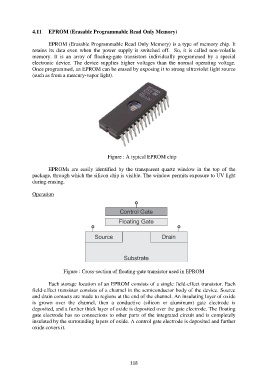
                                                 Figure : A typical EPROM chip

                       EPROMs  are  easily  identified  by  the  transparent  quartz  window  in  the  top  of  the
               package, through which the silicon chip is visible. The window permits exposure to UV light
               during erasing.

               Operation


                             Figure : Cross-section of floating-gate transistor used in EPROM

                       Each storage location of an EPROM consists of a single field-effect transistor. Each
               field-effect transistor consists of a channel in the semiconductor body of the device. Source
               and drain contacts are made to regions at the end of the channel. An insulating layer of oxide
               is  grown  over  the  channel,  then  a  conductive  (silicon  or  aluminum)  gate  electrode  is
               deposited, and a further thick layer of oxide is deposited over the gate electrode. The floating
               gate electrode has no connections to other parts of the integrated circuit and is completely
               insulated by the surrounding layers of oxide. A control gate electrode is deposited and further
               oxide covers it.


                                                           118

