


Page 120 - Digital Electronics by harish
P. 120
4.13 Flash memory
Flash memory is a form of non-volatile memory (EEPROM) that can be electrically
erased and reprogrammed. It is erased and programmed in blocks consisting of multiple
locations (usually512 bytes in size). Flash memory costs far less than EEPROM and therefore
has become the dominant technology wherever a significant amount of non-volatile, solid-
state storage is needed.
Examples of Flash memory:
Computer's BIOS (Basic Input Output System) chip
USB flash drives
Compact Flash (digital cameras)
Smart Media (digital cameras)
Memory Stick (digital cameras and cell phones)
There are two types of flash memory.
1. NOR flash
2. NAND flash
The characteristics of flash memory vary according to its type.
NOR flash
NOR-based flash has long erase and write times, but has a full address/data (memory)
interface that allows random access to any location. This makes it suitable for storage of
program code that needs to be infrequently updated, such as a computer's BIOS or the
firmware of set-top boxes. Its endurance is 10,000 to 1,000,000 erase cycles.
NAND flash
NAND flash has faster erase and write times, higher density, and lower cost per bit
than NOR flash, and ten times the endurance. However its I/O interface allows only
sequential access to data. This makes it suitable for mass-storage devices such as PC cards
and various memory cards, and somewhat less useful for computer memory.
A blank flash memory has all cells as 1‟s.It can be read or programmed a byte or word
at a time in a random fashion, but it can only be erased a block at a time. Once a byte has
been programmed it cannot be changed again until the entire block is erased. Erasing is
applied to one or more blocks by the application of a high voltage that returns all cells to a 1
state.
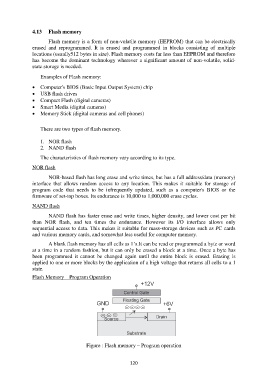
Flash Memory – Program Operation
Figure : Flash memory – Program operation
120

