


Page 122 - Digital Electronics by harish
P. 122
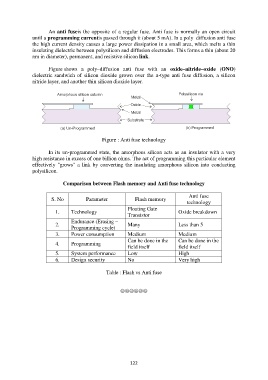
An anti fuseis the opposite of a regular fuse. Anti fuse is normally an open circuit
until a programming currentis passed through it (about 5 mA). In a poly–diffusion anti fuse
the high current density causes a large power dissipation in a small area, which melts a thin
insulating dielectric between polysilicon and diffusion electrodes. This forms a thin (about 20
nm in diameter), permanent, and resistive silicon link.
Figure shows a poly–diffusion anti fuse with an oxide–nitride–oxide (ONO)
dielectric sandwich of silicon dioxide grown over the n-type anti fuse diffusion, a silicon
nitride layer, and another thin silicon dioxide layer.
Figure : Anti fuse technology
In its un-programmed state, the amorphous silicon acts as an insulator with a very
high resistance in excess of one billion ohms. The act of programming this particular element
effectively "grows" a link by converting the insulating amorphous silicon into conducting
polysilicon.
Comparison between Flash memory and Anti fuse technology
Anti fuse
S. No Parameter Flash memory
technology
Floating Gate
1. Technology Oxide breakdown
Transistor
Endurance (Erasing –
2. Many Less than 5
Programming cycle)
3. Power consumption Medium Medium
Can be done in the Can be done in the
4. Programming
field itself field itself
5. System performance Low High
6. Design security No Very high
Table : Flash vs Anti fuse
122

