


Page 130 - Digital Electronics by harish
P. 130
1. Accumulator (A-register)
It is an 8-bit register. It is associated with ALU. The accumulator is also
called A-register. During the arithmetic / logic operations, one of the operand is
available in Accumulator. The result of the arithmetic / logic operations is also
stored in the Accumulator.
2. Temporary (TEMP) register
It is an 8-bit register. It is also associated with ALU. This register is used to
hold one of the data (from memory or general purpose registers) during an
arithmetic / logic operation.
3. Arithmetic and Logic Unit (ALU)
The Arithmetic and Logic Unit includes Accumulator, Temporary register,
arithmetic and logic circuits and flag register. The ALU can perform arithmetic
(such as addition and subtraction) and logic operations (such as AND, OR and
EX-OR) on 8-bit data. It receives the data from accumulator and or TEMP
register. The result is stored in the accumulator. The conditions of the result
(such as carry, zero) are indicated in the flags.
4. Flag register
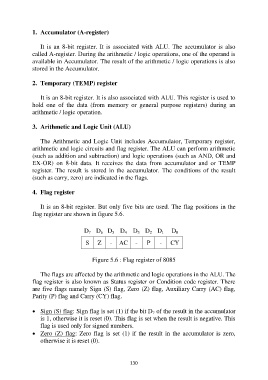
It is an 8-bit register. But only five bits are used. The flag positions in the
flag register are shown in figure 5.6.
D D D D D D D D
5
1
3
7
4
2
0
6
S Z - AC - P - CY
Figure 5.6 : Flag register of 8085
The flags are affected by the arithmetic and logic operations in the ALU. The
flag register is also known as Status register or Condition code register. There
are five flags namely Sign (S) flag, Zero (Z) flag, Auxiliary Carry (AC) flag,
Parity (P) flag and Carry (CY) flag.
Sign (S) flag: Sign flag is set (1) if the bit D of the result in the accumulator
7
is 1, otherwise it is reset (0). This flag is set when the result is negative. This
flag is used only for signed numbers.
Zero (Z) flag: Zero flag is set (1) if the result in the accumulator is zero,
otherwise it is reset (0).
130

