


Page 319 - YG 2019
P. 319
TECHNICAL                TECHNICAL
 DATA                     DATA


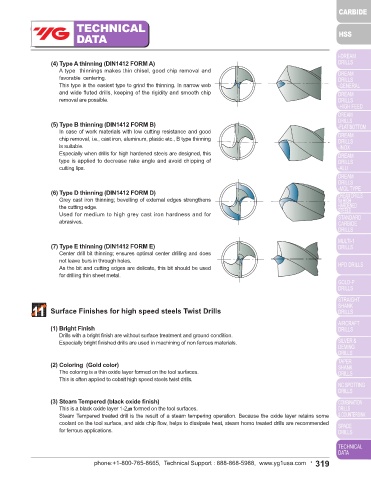
 9  Resharpening Twist Drills   (4) Type A thinning (DIN1412 FORM A)
                    A type  thinnings makes thin chisel, good chip removal and
                    favorable  centering.
                    This type is the easiest type to grind the thinning. In narrow web
 (1) Drills are worn off irregularly. It should be sharpened prior to developing into excessive wear.
                    and wide fluted drills, keeping of the rigidity and smooth chip
                    removal are possible.
 (2) Resharpening
    ①  Grind the correct point angle to suit your application. (figure 8)
    ②  Check that both cutting lips have the same angle. On a 130° point, each lip should be 65° toward the axis. The
 point must be on center, i.e., the chisel edge must produce cutting lips of equal length. (figure 8)   (5) Type B thinning (DIN1412 FORM B)
    ③  Grind Primary relief and Secondary clearance. (figure 9)  In case of work materials with low cutting resistance and good
    ④  Grind web thinning. (figure 10)  chip removal, i.e., cast iron, aluminum, plastic etc., B type thinning
                    is suitable.
 Primary            Especially when drills for high hardened steels are designed, this
 =  =  relief
 angle              type is applied to decrease rake angle and avoid chipping of
                    cutting lips.


 Point  =  =  Secondary
 angle  clearance  (6) Type D thinning (DIN1412 FORM D)
 angle              Grey cast iron thinning; bevelling of external edges strengthens
 Web thinning
                    the cutting edge.
                    Used for medium to high grey cast iron hardness and for
 Figure 8  Figure 9  Figure 10  abrasives.


 10  Web thinning     (7) Type E thinning (DIN1412 FORM E)
                    Center drill bit thinning; ensures optimal center drilling and does
                    not leave burs in through holes.
 (1) Without thinning
 Suitable for drill of general purpose.  As the bit and cutting edges are delicate, this bit should be used
 Thanks to thin web thickness, web thinning is not needed.  for drilling thin sheet metal.
 This without web thinning type is applied to design of drills for
 mild steels, alloy steels, cast iron, stainless steels, titanium,
 inconel, etc. and conventional cutting conditons.
            11    Surface Finishes for high speed steels Twist Drills

 (2) Type C thinning (DIN1412 FORM C, SPLIT POINT)
 Because Split point enables good centering when drilling and   (1) Bright Finish
 breaks the chips, chip removals are easy.     Drills with a bright finish are without surface treatment and ground condition.
 Suitable for drill design in high hardened tough materials, i.e,      Especially bright finished drills are used in machining of non ferrous materials.
 heat treated steels, titanium alloys, stainless steels, incoroy
 inconel, nimonic, etc.
                  (2) Coloring  (Gold color)
                     The coloring is a thin oxide layer formed on the tool surfaces.
 (3) Type R thinning (HELICAL THINNING)     This is often applied to cobalt high speed steels twist drills.
 Helical thinning ensures to frequent chip breaking and removal.
 The different direction force of cutting edges and helical thinning
 parts enable that chips curl, break and remove through the flutes.   (3) Steam Tempered (black oxide finish)
 In addition, helical thinning makes the chip room up to center,      This is a black oxide layer 1-2㎛ formed on the tool surfaces.
 remove the chisel and enables good centering     Steam Tempered treated drill is the result of a steam tempering operation. Because the oxide layer retains some
                    coolant on the tool surface, and aids chip flow, helps to dissipate heat, steam homo treated drills are recommended
                    for ferrous applications.


 318  • phone:+1-800-765-8665,  Technical Support : 888-868-5988,  www.yg1usa.com  phone:+1-800-765-8665,  Technical Support : 888-868-5988,  www.yg1usa.com  • 319

