


Page 139 - History of The Quranic Text | Kalamullah.Com
P. 139
THE HISTORY OF ARABIC PALAEOGRAPHY           119

                                   H(iHf\H,'\rTH~t
                                    rOVCOA/\E.OY
                                   .,.PO.:p Eoyc rA~1
                                   tv1 Ae ov BI\. c\f\cvc
                                   0A        NOYHNW!'S

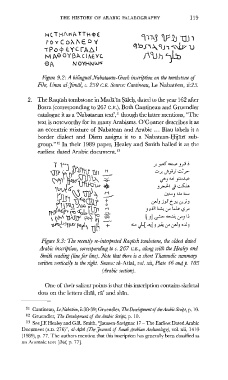
                                  Figure 9.2: A bilingual Nobataean-Greek inscription on the tombstone if
                                 Fihr; Umm al-Jimal, c. 250 C.E. Source: Cantineau, Le Nabateen, ii:25.

                             2. The Raqush tombstone in Mada'ln Saleh, dated to the year 162 after
                                 Bosra (corresponding to 267 C.E.). Both Cantineau and Gruendler
                                 catalogue it as a 'Nabataean text', II though the latter mentions, "The
                                 text is noteworthy for its many Arabisms. O'Conner describes it as
                                 an eccentric mixture of Nabatean and Arabic ... Blau labels it a
                                 border dialect and Diem assigns it to a Nabatean-Hijazi sub-
                                 group."12 In their 1989 paper, Healey and Smith hailed it as the
                                 earliest dated Arabic document. 13

                                                                        J!.r.£ ~ JP;~
                                                                         ":;';J!J-';)~?
                                                                           -.?'J ..... 1 p-¥
                                                                          J~IJ~
                                                                            ~J~~
                                                                        .rlJ jy cft! 01-;J
                                                                      J.;;i!I ~ <f ~ I.,?.r"
                                                                      [J] ~~<fJI~
                                                                 -.;.. J-[..A,!JJ ~<f.rlJ o..0J

                                  Figure 9.3: The recently re-interpreted Raqiish tombstone, the oldest dated
                                 Arabic inscription, corresponding to c. 267 C.E., along withthe Healey and
                                  Smith reading (lineJOr line). Note thatthere isa short Thamudic summary
                                 written oertically to the right. Source: al-Adal, ool. xii, Plate 46 andp. 105
                                                       (Arabic section).

                                   One of their salient points is that this inscription contains skeletal
                                 dots on the letters dhal, ra' and shin.


                             11 Cantineau, LeNabaieen, ii;38-39; Gruendler, TheDeoelopmentoftheArabic Script, p. 10.
                             12 Gruendler, TheDevelopment of theArabic Script, p. 10.
                             13 See].E Healey and G.R. Smith, 'Jaussen-Savignac 17- The Earliest Dated Arabic
                           Document (A.D. 276)", al-Ailal(The]ournal ofSaudi Arabian Archaeology), vol. xii, 1410
                           (1989), p. 77. The authors mention that this inscription has generally been classifiedas
                           an Aramaic text [ibid, p. 77].

