


Page 142 - History of The Quranic Text | Kalamullah.Com
P. 142
122           THE HISTORY OF THE QUR'ANIC TEXT

                                           iii. TheEarly Arabic Language Possessed a Distinct Alphabet


                                   Turning our attention to Dr. Mingana's hypothesis that early Arabic lacked
                                   an alphabet, I will present a few dated and highly developed inscriptions
                                   which clearly show otherwise. There are many Arabic inscriptions from the
                                   6th century C.E. which very nearly approach the Arabic palaeography used
                                   in the first century of A.H.Iseventh century C.E.; my examples willprogress
                                   from these into the Islamic era.
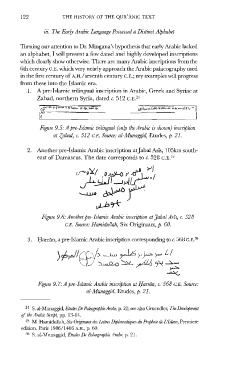
                                     1. A pre-Islamic trilingual inscription in Arabic, Greek and Syriac at
                                        Zabad, northern Syria, dated c. 512 C.E.  24
                                         II~f.... 99>'-'"' q q ~ >' ""}-'Ui-  u.OJ{,.""L&> 9 qll.>.o.£o'", ,,_ <JlU r +  \


                                         Figure 9.5: A pre-Islamic trilingual (only the Arabic is shown) inscription
                                              at:(,abad, c. 512 C.E. Source: al-Munaggid, Etudes, p. 21.

                                     2. Another pre-Islamic Arabic inscription atJabal Asis, 105km south-
                                                                                       25
                                         east of Damascus. The date corresponds to c. 528 C.E.


                                          Figure 9.6: Another pre-Islamic Arabic inscription atJabalASls, c. 528
                                                  C.E. Source: Hamidullah, Six Originaux, p. 60.

                                     3. Harran, a pre-Islamic Arabic inscription corresponding to c. 568 C.E. 26


                                         Figure 9.7: A pre-Islamic Arabic inscription at Harriin, c. 568 C.E. Source:
                                                         al-Munaggid, Etudes, p. 21.


                                     24 S.al-Munaggid, EtudesDePaleographieArabe, p. 21; seealso Gruendler, TheDevelopment
                                   II! theArabic Script, pp. 13-14.
                                     25 M. Hamidullah, SixOriginaux des LettresDiplomatiques duProphete de L'lslam, Premiere
                                   edition, Paris 1986/1406 A.H., p. 60.
                                     26 S. al-Munaggid, Etudes De Paleographie Arabe, p. 21.

