


Page 333 - History of The Quranic Text | Kalamullah.Com
P. 333
THE ORIENTALIST AND THE QUR'AN             313


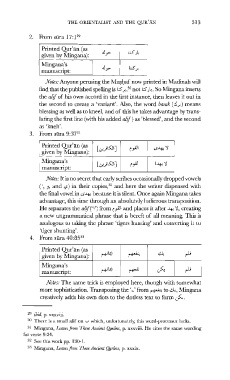
                              2. From sura I7:12 9
                                  Printed Qur'an (as   .uy
                                  given by Mingana):            l.:S),
                                  Mingana's            .uy
                                  manuscript:                   l.:S.;:
                                   Notes: Anyone perusing the Mushaf now printed in Madinah will
                                 find that the published spellingis LS.;:,30 not LSJ~' SOMingana inserts
                                 the alij of his own accord in the first instance, then leaves it out in
                                 the second to create a 'variant'. Also, the word barak (!l.;:) means
                                 blessing as well as to kneel, and of this he takes advantage by trans-
                                 lating the first line (with his added alij) as 'blessed', and the second
                                 as 'knelt'.
                              3. From sura 9:37  31

                                 I Printed Qur'an (as  [J-)l5:JI]  i..,All  ..s~ 'i
                                  given by Mingana):                  I         I
                                  Mingana's
                                                     [J-)l5:J\]  i..,Al  I~'i
                                  manuscript:
                                    Notes: It is no secret that early scribes occasionally dropped vowels
                                 (I, J, and i.?) in their copies," and here the writer dispensed with
                                 the final vowel in ..s~ because it is silent. Once again Mingana takes
                                 advantage, this time through an absolutely ludicrous transposition.
                                 He separates the alij(' \') from i..,All and places it after --4;'i, creating
                                 a new ungrammatical phrase that is bereft of all meaning. This is
                                 analogous to taking the phrase 'tigers hunting' and converting it to
                                  'tiger shunting'.
                              4. From sura 40:85  33
                                  Printed Qjir'an (as
                                  given by Mingana):   ~~J      ~         ~         ~
                                  Mingana's
                                  manuscript:          ~'-'.I   ~         ~         ~
                                    Notes: The same trick is employed here, though with somewhat
                                 more sophistication. Transposing the '..' from ~ to~, Mingana
                                  creatively adds his own dots to the dotless text to form~.


                             29 ibid, p. xxxviii.
                             30 There is a small alif on y which, unfortunately, this word-processor lacks.
                             31 Mingana, Leaoesfrom Three Ancient Qurans, p. xxxviii. He cites the same wording
                            for verse 9:24.
                             32 See this work pp. 130-1.
                             33 Mingana, Leaoesfrom Three Ancient Qyrans, p. xxxix.

