


Page 11 - Tafsir of surat at tawba repentance
P. 11
© Islamic Online University Usool at-Tafseer
asked if Allaah had mentioned him by name, the Prophet (r) told him yes, and
33
Ubayy cried. Ubayy’s most notable students were Zayd ibn Aslam, Aboo al
34
‘Aaliyah, and Muhammad ibn Ka‘b al-Qurathee.
In ‘Iraaq, Ibn Mas‘ood headed the most prominent school of tafseer.
‘Abdullaah ibn Mas‘ood, the sixth person to enter Islaam, 35 was among the top
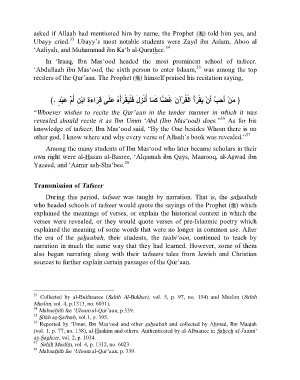
reciters of the Qur’aan. The Prophet (r) himself praised his recitation saying,
(. ٍﺩﺒﻋ ﻡُﺃ ِﻥﺒﺍ ِﺓﺀﺍﺭِﻗ ﻰﹶﻠﻋ ﻩْﺃﺭﹾﻘﻴﹾﻠﹶﻓ َلِﺯﹾﻨُﺃ ﺎﻤﹶﻜ ﺎﻀﹶﻏ ﻥﺁﺭﹸﻘﹾﻟﺍ َﺃﺭﹾﻘﻴ ﻥَﺃ ﺏﺤَﺃ ﻥﻤ )
“Whoever wishes to recite the Qur’aan in the tender manner in which it was
36
revealed should recite it as Ibn Umm ‘Abd (Ibn Mas‘ood) does.” As for his
knowledge of tafseer, Ibn Mas‘ood said, “By the One besides Whom there is no
37
other god, I know where and why every verse of Allaah’s book was revealed.”
Among the many students of Ibn Mas‘ood who later became scholars in their
own right were al-Hasan al-Basree, ‘Alqamah ibn Qays, Masrooq, al-Aswad ibn
38
Yazeed, and ‘Aamir ash-Sha‘bee.
Transmission of Tafseer
During this period, tafseer was taught by narration. That is, the sahaabah
who headed schools of tafseer would quote the sayings of the Prophet (r) which
explained the meanings of verses, or explain the historical context in which the
verses were revealed, or they would quote verses of pre-Islaamic poetry which
explained the meaning of some words that were no longer in common use. After
the era of the sahaabah, their students, the taabi‘oon, continued to teach by
narration in much the same way that they had learned. However, some of them
also began narrating along with their tafseers tales from Jewish and Christian
sources to further explain certain passages of the Qur’aan.
33
Collected by al-Bukhaaree (Sahih Al-Bukhari, vol. 5, p. 97, no. 154) and Muslim (Sahih
Muslim, vol. 4, p.1313, no. 6031).
34
Mabaahith fee ‘Uloom al-Qur’aan, p.339.
35
Sifah as-Safwah, vol.1, p. 395.
36
Reported by ‘Umar, Ibn Mas‘ood and other sahaabah and collected by Ahmad, Ibn Maajah
(vol. 1, p. 77, no. 138), al-Haakim and others. Authenticated by al-Albaanee in Saheeh al-Jaami‘
as-Sagheer, vol. 2, p. 1034.
37
Sahih Muslim, vol. 4, p. 1312, no. 6023.
38
Mabaahith fee ‘Uloom al-Qur’aan, p. 339.
http://www.islamiconlineuniversity.com 11

