


Page 30 - Tafsir of surat at tawba repentance
P. 30
© Islamic Online University Usool at-Tafseer
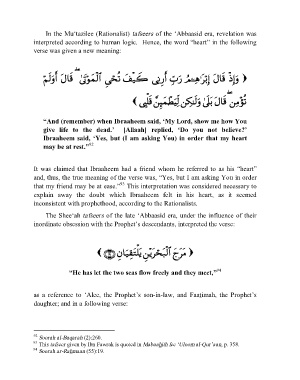
In the Mu‘tazilee (Rationalist) tafseers of the ‘Abbaasid era, revelation was
interpreted according to human logic. Hence, the word “heart” in the following
verse was given a new meaning:
öNs9urr& tA$s% ( 4tAöqyJø9$# Çósè? y#ø2 ÏRÍr& Éb>u ÞO¿Ïdºtö/Î) tA$s% øÎ)ur )
( ÓÉ<ù=s% £`ͳyJôÜuÏj9 `Å3»s9ur 4n?t/ tA$s% ( `ÏB÷sè?
“And (remember) when Ibraaheem said, ‘My Lord, show me how You
give life to the dead.’ [Allaah] replied, ‘Do you not believe?’
Ibraaheem said, ‘Yes, but (I am asking You) in order that my heart
92
may be at rest.”
It was claimed that Ibraaheem had a friend whom he referred to as his “heart”
and, thus, the true meaning of the verse was, “Yes, but I am asking You in order
93
that my friend may be at ease.” This interpretation was considered necessary to
explain away the doubt which Ibraaheem felt in his heart, as it seemed
inconsistent with prophethood, according to the Rationalists.
The Shee‘ah tafseers of the late ‘Abbaasid era, under the influence of their
inordinate obsession with the Prophet’s descendants, interpreted the verse:
( ÇÊÒÈ Èb$uÉ)tGù=t Ç`÷tóst7ø9$# ylttB )
94
“He has let the two seas flow freely and they meet,”
as a reference to ‘Alee, the Prophet’s son-in-law, and Faatimah, the Prophet’s
daughter; and in a following verse:
92
Soorah al-Baqarah (2):260.
93
This tafseer given by Ibn Fawrak is quoted in Mabaahith fee ‘Uloom al-Qur’aan, p. 358.
94
Soorah ar-Rahmaan (55):19.
http://www.islamiconlineuniversity.com 30

