


Page 17 - D&D - Player's Handbook
P. 17
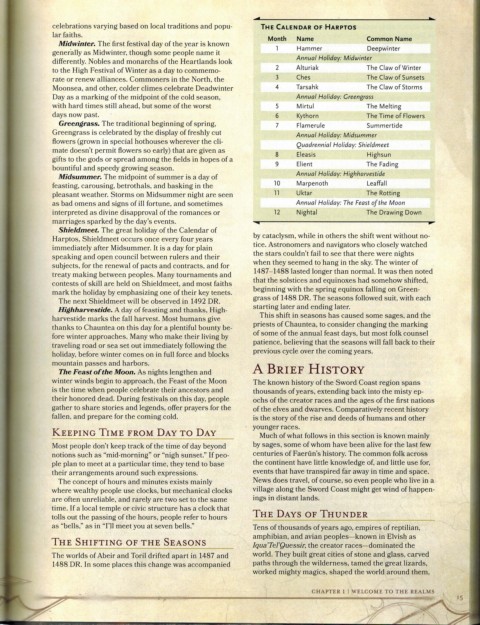
celebrations varying based on local traditions and popu-  THE CALENDAR OF  HARPTOS
              lar faiths.
                                                                   Month   Name             Common Name
               Midwinter. The' first festival day of the year is known
                                                                     l     Hammer           Deepwinter
              generally as Midwinter, though some people name it
                                                                           Annual Holiday:  Midwinter
              differently.  Nobles and monarchs of the Heartlands look
                                                                     2    Alturiak          The Claw of Winter
              to the High Festival of Winter as a day to commemo-
              rate or renew alliances. Commoners in the North, the   3     Ches             The Claw of Sunsets
              Moonsea, and other, colder climes celebrate Deadwinter   4   Tarsahk          The Claw of Storms
              Day as a marking of the midpoint of the cold season,        Annual Holiday:  Greengrass
              with hard times still ahead, but some of the worst     5     Mirtul           The Melting
              days now past.                                         6     Kythorn          The Time of Flowers
                Greengrass. The traditional beginning of spring,     7     Flamerule        Summertide
              Greengrass is celebrated by the display of freshly cut      Annual Holiday:  Midsummer
              flowers (grown in special hothouses wherever the cli-
                                                                           Quadrennial Holiday: Shieldmeet
              mate doesn't permit flowers so early) that are given as
                                                                     8     Eleasis          Highsun
              gifts to the gods or spread among the fields in hopes of a
                                                                     9     Elient           The  Fading
              bountiful and speedy growing season.
                                                                          Annual Holiday: Highharvestide
               Midsummer. The midpoint of summer is a day of
              feasting, carousing, betrothals, and basking in the    10    Marpenoth        Leaffall
              pleasant weather.  Storms on Midsummer night are seen   11   Uktar            The Rotting
              as bad omens and signs of ill fortune, and sometimes        Annual Holiday:  The Feast of the Moon
              interpreted as divine disapproval of the romances or   12    Nightal          The Drawing Down
              marriages sparked by the day's events.
                Shieldmeet. The great holiday of the Calendar of
                                                                by cataclysm, while in others the shift went without no-
              Harptos, Shieldmeet occurs once every four years
                                                                tice. Astronomers and navigators who closely watched
              immediately after Midsummer. It is a day for plain
                                                                the stars couldn't fail to see that there were nights
              speaking and open council between rulers and their
                                                                when they seemed to hang in the sky. The winter of
              subjects, for the renewal of pacts and contracts, and for
                                                                1487- 1488 lasted longer than normal. It was then noted
              treaty making between peoples. Many tournaments and
                                                                that the solstices and equinoxes had somehow shifted,
              contests of skill are held on Shieldmeet, and most faiths
                                                                beginning with the spring equinox falling on Green-
              mark the holiday by emphasizing one of their key tenets.
                                                                grass of 1488 DR. The seasons followed suit, with each
               The next Shieldmeet will be observed in 1492 DR.
                                                                starting later and ending later.
               Highharvestide. A day of feasting and thanks, High-
                                                                 This shift in seasons has caused some sages, and the
              harvestide marks the fall harvest. Most humans give
                                                                priests of Chauntea, to consider changing the marking
              thanks to Chauntea on this day for a plentiful bounty be-
                                                                of some of the annual feast days, but most folk counsel
              fore winter approaches. Many who make their living by
                                                                patience, believing that the seasons will fall back to their
              traveling road or sea set out immediately following the
                                                                previous cycle over the coming years.
              holiday, before winter comes on in full force and blocks
              mountain passes and harbors.
                The Feast of the Moon. As nights lengthen and   A BRIEF HISTORY
              winter winds begin to approach, the Feast of the Moon   The known history of the Sword Coast region spans
              is the time when people celebrate their ancestors and   thousands of years, extending back into the misty ep-
              their honored dead. During festivals on this day,  people   ochs of the creator races and the ages of the first nations
              gather to share stories and legends, offer prayers for the   of the elves and dwarves. Comparatively recent history
              fallen, and prepare for the coming cold.          is the story of the rise and deeds of humans and other
                                                                younger races.
              KEEPING TIME  FROM  DAY TO DAY                     Much of what follows in this section is known mainly
              Most people don't keep track of the time of day beyond   by sages, some of whom have been alive for the last few
              notions such as "mid-morning" or "nigh sunset." If peo-  centuries of Faerfm's history. The common folk across
              ple plan to meet at a particular time, they tend to base   the continent have little knowledge of, and little use for,
              their arrangements around such expressions.       events that have transpired far away in time and space.
               The concept of hours and minutes exists mainly   News does travel, of course, so even people who live in a
              where wealthy people use clocks, but mechanical clocks   village along the Sword Coast might get wind of happen-
              are often unreliable, and rarely are two set to the same   ings in distant lands.
              time. If a local temple or civic structure has a clock that
              tolls out the passing of the hours, people refer to hours   THE DAYS  OF THUNDER
              as "bells," as in "I'll meet you at seven bells."   Tens of thousands of years ago, empires of reptilian,
                                                                amphibian, and avian peoples- known in Elvish as
              THE  SHIFTING OF THE  SEASONS                     Jqua'Tel'Quessir, the creator races- dominated the
              The worlds of Abeir and Tori! drifted apart in 1487 and   world. They built great cities of stone and glass, carved
              1488 DR. In some places this change was accompanied   paths through the wilderness, tamed the great lizards,
                                                                worked mighty magics, shaped the world around them,

                             -~~--~~~"""'"' ____________________________ ,..._
                                                                              CHAPTER  I  I WELCOME TO THE REALMS

