


Page 40 - D&D - Player's Handbook
P. 40
far to walk to, a small shrine to Sune often stands near   the first silver smelted, and the first iron forged. He uses
         a street corner. These sites consist of a mirror hung   these staffs to raise destructive winds, cause terrible
         beneath a small roof where one can say a prayer while   storms, and split the land in acts of rage. The three light-
         checking one's appearance. The spot might feature a   ning bolts of his holy symbol represent these staffs, and
         shelf or a cupboard holding various perfumes and cos-  when he vents his wrath on the world, he is thought to
         metics so that those without the funds to purchase such   hurl them down from the sky as lightning strikes.
         items can still make themselves feel beautiful.     Although Talos is a popular deity, his name is invoked
                                                           more often out of fear than out of reverence. He does
         TALON A                                           have priests, mostly traveling doomsayers, who warn
         Lady of Poison, Mistress of Disease, the Plague-crone   of disasters to come and accept charity in exchange for
                                                           blessings of protection. Many of his faithful wear a black
         One of the most often beseeched of FaerO.n's deities,
                                                           eyepatch, even if both eyes are intact.
         Talona is the goddess of disease and poison, blamed for
         everything from common illnesses to crop failure to brack-  TEMPUS
         ish wells to plague. Depicted in temple iconography as a
                                                           The Foehammer, the Lord of Battles
         withered crone with a cup or a vase that holds all the vari-
         eties of disease and poison, Talona is a fearsome goddess,   Tempus is a war god concerned with brave conduct
         and many are the prayers that beg her for protection from   during war, using force of arms over talk for settling
         illness and poison. Various rituals to placate her involve the   disputes, and encouraging bloodshed. The god of war is
         use of three drops of blood or three tears- to be dropped   random in his favors, meaning that his chaotic nature fa-
         into a well that has gone bad, dripped into the handkerchief   vors all sides equally. Lord Tempus might be an army's
         of someone beset by coughing, dropped into a fire made   ally one day, and its enemy the next. He might seem to
         by burning a withered crop, dripped into the mouth of a   manifest before a battle, appearing to one side or the
         plague sufferer, and so on. It's common practice to mark a   other. If he is seen riding a white mare (Veiros), then the
         container of poison with her holy symbol, three droplets in   army will succeed. If he rides a black stallion (Deiros),
         a triangle, and during epidemics folk paint the same image   then defeat is certain. Most often he appears to be rid-
         on the homes of the infected.                     ing with one foot in each mount's stirrup, signifying the
           Though she is often the recipient of prayers, Talona   unpredictable nature of battle. In such visions, Tempus
         has almost no temples and few cults dedicated to her. A   is always a powerfully built warrior dressed for battle in
         cult or a shrine to her might arise in an area after it suf-  the style of those who envision him.
         fers from pestilence, when some of those who survived   Tempus's favor might be randomly distributed, but
         decide to revere her or even become priests.      over the centuries his priests have made an effort to
                                                           spread and enforce a common code of warfare-to make
         TALOS                                             war a thing of rules, respect for reputations, and pro-
                                                           fessional behavior. This code, called Tempus's Honor,
         S tormlord, the Destroyer
                                                           has the purpose of making conflicts brief, decisive, and
         Talos is the dark side of nature, the uncaring and de-
                                                           as safe as possible for those not directly involved. The
         structive force that might strike at any time. He is the
                                                           rules in the code include the following: arm anyone who
         god of storms, forest fires, earthquakes, tornadoes, and
                                                           has need of a weapon; disparage no foe; acquit oneself
         general destruction. He counts the ravager, the raider,
                                                           with bravery; train all for battle; and don't engage in
         the looter, and the brigand among his followers. Those
                                                           feuds. Those who poison wells, taint fields, kill noncom-
         who favor him see life as a succession of random effects
                                                           batants, or engage in torture in the name of war are all
         in a sea of chaos, so the devout should grab what they
                                                           considered sinners.
         can, when they can-for who can say when Talos will
                                                            Worshipers of Tempus are legion, and his name is
         strike and send them into the afterlife?
                                                           often on the lips of soldiers. His priests are tacticians,
           Talos is portrayed as a broad-shouldered, bearded
                                                           often skilled in the art of war. Many of his ordained
         young man with a single good eye, the other covered
                                                           don't serve in temples, but as battlefield chaplains with
         by a dark patch. He is said to carry a collection of three
                                                           armies and mercenary companies, encouraging their
         staffs, made from the first tree cut down in the world,
                                                           fellow soldiers with both word and blade. Priests of
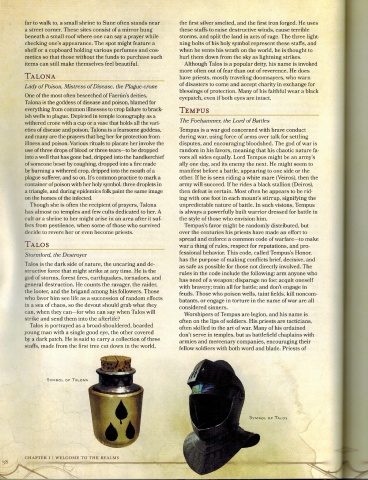
                SYM B OL  OF  T ALONA


                                                                                  SvMBOL  OF TALCS


         CHAPTER 1  I WELCOME TO THE  REALMS

