


Page 36 - D&D - Player's Handbook
P. 36
games. Ordinary folk pray to him to avert his eyes from   She has many shrines, particularly in the Savage
         their valuables, but the cautious sometimes employ   Frontier. Most consist of a dead tree trunk into which
         "Mask's purse," a small, cheap cloth pouch worn in plain   has been carved a likeness of her holy symbol, a uni-
         sight (thus easily cut or lifted) containing a small offer-  corn's head. Alternatively, the likeness might be carved
         ing of coin. By convention, a pickpocket pilfers Mask's   on a separate piece of wood and tacked to a living
         purse when encountering another person wearing one,   tree. These shrines typically mark the point in a forest
         and considers the gain a gift from the god, while the one   beyond which locals know not to cut timber or hunt.
         who lost the purse is grateful to the Lord of Shadows for   Often these tributes are created by loggers at the end
         accepting a respectful sacrifice of a small portion of his   of a logging excursion as a mark of thanks to the god-
         goods. Of course, nothing prevents another pickpocket   dess for providing the wood and for keeping the timber
         from targeting someone who has lost Mask's purse, but   cutters safe during the work.
         anyone with the ill luck to attract multiple pickpockets in
         a single outing has probably earned Mask's ire anyway.   MI LIL
           Priests of Mask are usually thieves by profession, and
                                                           The Lord of Song, the One True Hand of All-Wise
         often serve as higher-ups in the local underworld or   Oghma
         criminal syndicate. They go by the title of demarche or
         demarchess, and wear veil-masks when acting in their   Milil is the god of poetry, eloquence, and song. He is
         priestly capacity.                                a god of creativity and inspiration, of the entire song
                                                           more than just the lyrics or the music. He represents
         MIELIKKI                                          the finished thought, the result of the process that takes
                                                           an idea from conception to realization. Milil is most
         Our Lady of the Forest, the Forest Queen
                                                           venerated by bards, troubadours, and other entertain-
         People rarely speak of Mielikki except in quiet forest   ers, but anyone preparing to entertain or speak before
         spaces. Woodlands that evoke wonder are where she   a crowd might offer Milil a brief prayer for a successful
         reigns supreme, but she is said to keep watch over good   performance. Those who seek inspiration in a creative
         folk in any forest, not matter how dark or cruel. When   endeavor also pray to Milil.
         children are lost in the woods, people beseech Mielikki   His icons depict him as a handsome male, sometimes
         to protect them until they are found.             a human, sometimes an elf, and even a half-elf in places
           Mielikki is the goddess of the forest and the creatures   (such as Aglarond) that have a large half-elf population.
         that live within it. She is seen as a remote and spiritual   He is variously depicted as young or old, but his identity
         deity- less human-like than many other gods. She's   is always apparent because of his five-stringed harp
         not unmindful of people, but her attention and favor   made of silvery leaves, which he carries constantly.  He
         are difficult to attract. She is the patron of rangers in   is the ideal to which all performers aspire: poised and
         the same way that Milil is the patron of bards, but even   confident, winningly charismatic, and a source of in-
         rangers rarely pray to her directly. They instead pray to   spiration for those who listen to him. He is said to have
         Gwaeron Windstrom, who they believe will carry their   total recall of anything he hears or that is spoken while
         words to the goddess by tracking her to whichever forest   music plays, as well as utmost skill at improvisation.
         she hides in.                                       Holy sites dedicated to Milil are often found in per-
           Mielikki's symbol is a unicorn, which prompts some to   formance venues and schools of music. Whether the
         think of her as such and conflate her with Lurue, Queen   site is a vast concert hall or a small choral chamber, it
         of the Unicorns and the actual goddess of their kind. But   must have excellent acoustic qualities. Milil's priests
         most tales depict Mielikki as a beautiful woman whom   are patrons of the arts in addition to being performers
         Lurue allows upon her back as a rider, and the two are   themselves, and they frequently act as tutors in the arts
         thought to be boon companions. Mielikki's relationships   of performance at his shrines and temples.
         with other deities of the natural world are more com-  Like Deneir, Milil is sometimes thought of as being
         plex. Silvanus is sometimes thought of as her father and   in service to Oghma. In these portrayals of the deity,
         Eldath is considered her sister, but Mielikki walks her   Milil is the god's left hand, also referred to as the One
         own path through the wilds.                       True Hand. This expression isn't meant to denigrate
                                                           the right hand (Deneir); rather, it stems from the fact


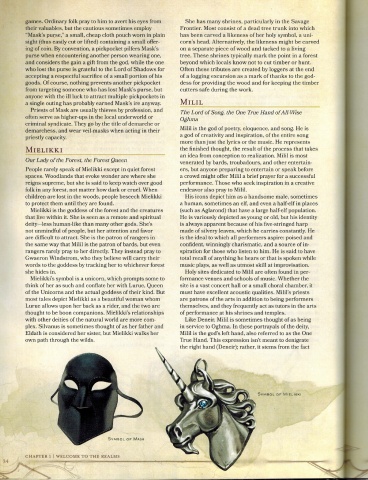
                                                                                    SYMBOL OF  MIELIKKI


                                    SYMBOL  OF  MASK


         CHAPTER l  I WELCOME TO THE REALMS

