


Page 37 - D&D - Player's Handbook
P. 37
that left-handedness is more often associated with great   those who use magic or magical objects in their daily
           artistic ability and the belief that the greatest art comes   lives. She also receives the prayers of those who find
           from the ~cceptance of truth.                     magic wondrous or encounter magic they fear. Mystra is
                                                             the goddess of the essential force that makes all spell-
           MYRKUL                                            casting possible. She provides and tends the Weave, the
                                                             conduit through which mortal spellcasters and magical
           The Lord of Bones, Old Lord Skull, the Reaper
                                                             crafters can safely access the raw force of magic.
           Myrkul is an ancient god, one of three former mortals   The faith of Mystra is pervasive in FaerOn, which is to
           who were raised to deityhood whenJergal grew weary of   be expected for a land as touched by magic as it is. Her
           his divine duties and distributed his influence between   worshipers include those who use magic or work closely
           them. Myrkul became the god of death and the dead,
                                                             with it, such as alchemists and sages. The blue-clad
           and ruled over the City of the Dead for centuries until   priests of Mystran temples count wizards and sorcerers
           he, in turn, was slain. In time Myrkul returned, for can   among their numbers, as well as the occasional bard.
           death itself truly ever die? Myrkul's faithful see him as   The goal of Mystra's faithful is simple: that magic be
           the Reaper, who lays claim to souls and brings them to   preserved and promulgated throughout the Realms.
           Kelemvor to be judged.                            It isn't unusual for her followers to keep an eye out for
            Myrkul is a deity of death, decay, old age, exhaustion,   those who demonstrate high potential for using magic
           dusk, and autumn. He's the god of the ending of things   and help arrange for such persons to find tutelage with a
           and hopelessness, as much as Lathander is the god of   suitable mentor.
           beginnings and hope. Folk don't pray to Myrkul so much
           as dread him and blame him for aching bones and fading   OGHMA
           vision. Myrkul is thought to be passionless and uncaring
                                                             The Binder,  the Lord of Knowledge
           even of his most devout worshipers. Those who take
           Myrkul as a patron tend to be morose, taciturn, and ob-  Oghma is the god of inspiration, invention, and knowl-
           sessed with the dead and the undead. Like many follow-  edge. Above all else, Oghma represents knowledge
           ers ofKelemvor andJergal, priests ofMyrkul serve as un-  in its most supreme, raw form- the idea. An aphorism
           dertakers and typically keep their patron's identity secret.   cited by his faithful about this concept serves them as
            Shrines to Myrkul or engravings of his holy symbol   a prayer when it is repeated aloud: "An idea has no heft
           appear in many places where humans bury their dead,   but it can move mountains. An idea has no authority
           but full-fledged temples are rare. The few that exist are   but it can dominate people. An idea has no strength but
           hallowed places where the dead from hundreds of miles   it can push aside empires. Knowledge is the greatest
           around are brought for internment, even if they were not   tool of the mortal mind, outweighing anything made by
           of Myrkul's faith. There is little space set aside for the   mortal hands. Before anything else can exist, the idea
           living in such a location, usually a single modest shrine,   must exist."
           but its catacombs and ossuaries are vast. In the deepest   Oghma's faithful spread knowledge and literacy as
           chamber of each temple rests a throne, and upon that   widely as possible, believing that minds ought never to
           throne sits the doomwarden- the preserved corpse   be shackled by ignorance and thus not be able to be-
           of the most revered saint in the history of the temple   queath the benefit  they might otherwise provide their
           (often its founder). Initiates to the faith are brought to   fellows. Not surprisingly,  those who follow Oghma op-
           kneel before a temple's doomwarden, where they must   pose those who foster deceit, trickery, and ignorance.
           spend a night and a day fasting and meditating in com-  Folk of many professions favor the Binder: wizards,
           plete darkness.                                   cartographers, artists, bards, clerks, inventors, sages,
                                                             scribes, and all manner of others who uncover, pre-
           MYSTRA                                            serve, and create knowledge and learning. The worship
                                                             of Oghma was, at one point, one of the few organized
           The Lady of Mysteries, Our Lady of Spells, the Mother
                                                             faiths in FaerOn that had an established orthodoxy and
           of All Magic
                                                             a complete network of temples that adhered to that or-
           Mystra is the goddess of magic, and with that the god-
                                                             thodoxy. Schisms during the Time of Troubles shattered
           dess of possibilities. She is venerated by mages and by   that network, and now the structures that house the


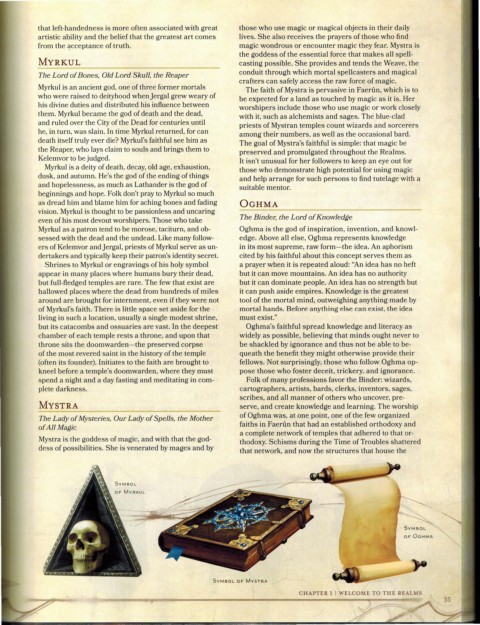
                                                                                                     SvMBOL
                                                                                                     O F  0GHMll


                                                      SvM B O L  OF  M vs TR ll
                                                                           CHAPTER l  I WELCOME TO THE  REALMS

