


Page 321 - Robot Design Handbook ROBOCON Malaysia 2019
P. 321
2.2  Electronics and Programming

                         For the electronics  part, the component that we used to  move the robot’s  leg is

                  Analog Servo – HD-1501MG with 60 g of weight and the stall torque is 17 kg/cm. In order
                  to make the robot able to turn left, the turning process will make the left leg takes a small

                  step while the right leg takes a huge step, and vice versa. For the part where the robot throws
                  the Shagai, the component used is a DC Motor. Each of the components used is powered

                  and supplied by a 7.4 V 2200 mAh battery. The connection synmethic only involves the
                  MR1 and the MR2. For the MR1, cable connection control is used in order to prevent noise

                  of “wireless” (interference occurs).

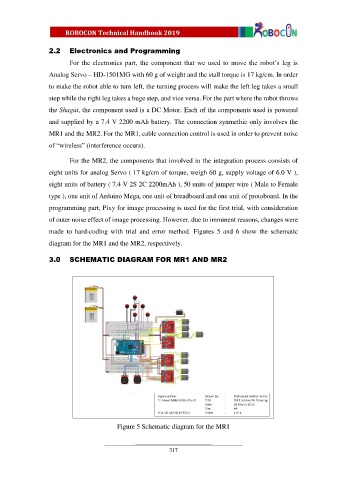
                         For the MR2, the components that involved in the integration process consists of

                  eight units for analog Servo ( 17 kg/cm of torque, weigh 60 g, supply voltage of 6.0 V ),

                  eight units of battery ( 7.4 V 2S 2C 2200mAh ), 50 units of jumper wire ( Male to Female
                  type ), one unit of Arduino Mega, one unit of breadboard and one unit of protoboard. In the

                  programming part, Pixy for image processing is used for the first trial, with consideration
                  of outer noise effect of image processing. However, due to imminent reasons, changes were

                  made  to  hard-coding  with  trial  and  error  method.  Figures  5  and  6  show  the  schematic
                  diagram for the MR1 and the MR2, respectively.


                  3.0    SCHEMATIC DIAGRAM FOR MR1 AND MR2


                                          Figure 5 Schematic diagram for the MR1


                                                            317

