


Page 13 - Drug Discovery and Development: Prospects and Challenges
P. 13
Drug Discovery and Development: Prospects and Challenges  /  3

             Brothers and sisters,
             Ladies and Gentlemen,


                    Natural Medicines According to Islamic
                             and Old Malay Scriptures


             The Islamic scriptures consisting of the Holy Qur’an and the hadith
             describe a number of natural remedies, such as Allium cepa L. (onion),
             A. sativum L. (garlic), Phoenix dactylifera L. (date), Lagenaria siceraria
             Standl. (pumpkin), Ficus carica L. (fig), Olea europea L. (olive), Lens
             culinaris Medic (adas), Hordeum vulgare L. (barlie), Punica granatum
             L. (pomegranate), Salvadora persica L. (siwak/miswak), Vitis vinifera L.
             (grape), and Zingiber officinale Roscoe (ginger) (El-Seedi et al., 2019).
             All the aforementioned natural medications have gained the interest of
             the global research community due to their healing efficacy. The number
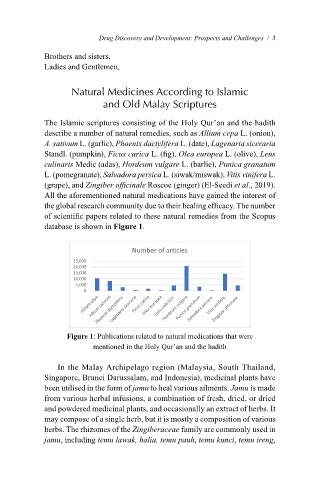
             of scientific papers related to these natural remedies from the Scopus
               community  due to their healing efficacy. The number of  scientific  papers  related to these natural
             database is shown in Figure 1.
               remedies from the Scopus database is shown in Figure 1.
                                     Number of articles

                     25,000
                     20,000
                     15,000
                     10,000
                     5,000
                        0
                                             Hordeum vulgare
                          Allium sativum
                       Allium cepa Phoenix dactylifera  Ficus carica Olea europea Lens culinaris  Punica granatum  Vitis vinifera
                                                           Zingiber officinale
                                                    Salvadora persica
                               Lagenaria siceraria

                   Figure 1: Publications related to natural medications that were
               Figure 1: Publications related to natural medications that were mentioned in the Holy Qur’an and the
                          mentioned in the Holy Qur’an and the hadith
                                               hadith

                 In the Malay Archipelago region (Malaysia, South Thailand,
                    In the Malay Archipelago region (Malaysia, South Thailand, Singapore, Brunei Darussalam,
             Singapore, Brunei Darussalam, and Indonesia), medicinal plants have
               and Indonesia), medicinal plants have been utilised in the form of jamu to heal various ailments. Jamu
             been utilised in the form of jamu to heal various ailments. Jamu is made
               is made from  various  herbal  infusions, a  combination  of fresh, dried,  or dried and  powdered
             from various herbal infusions, a combination of fresh, dried, or dried
               medicinal plants, and occasionally an extract of herbs. It may compose of a single herb, but it is
             and powdered medicinal plants, and occasionally an extract of herbs. It
               mostly a composition of various herbs. The rhizomes of the Zingiberaceae family are commonly used
             may compose of a single herb, but it is mostly a composition of various
               in jamu, including temu lawak, halia, temu pauh, temu kunci, temu ireng, and others. In addition,
             herbs. The rhizomes of the Zingiberaceae family are commonly used in
               individual plant, such as manjakarni, kacip Fatimah, misai kucing, tongkat ali, hempedu bumi, and
             jamu, including temu lawak, halia, temu pauh, temu kunci, temu ireng,
               kulim are also used as herbal medicine.
                    Instead of  verbal inheritance,  these  medical formulations  have  been passed down  over
               generations through documented handwriting in old manuscripts in different languages, such as Jawi
               (Malay, Aceh, and Minangkabau), Primbon (Java), Paririmbon (Sunda), and Bali (Indriasari, 2011).
               For example, the Jawi handwritten prescription was recorded in the Kitab Tip (medical or magical
               prescription), which described the use of medicinal plants (Aswandi Syahri, 2018), while the printed
               version of  the manuscript  had been  published  in the  20   century,  such as  in the  Cabe  Puyang
                                                       th
               Warisan Nenek Moyang that prescribed simple and direct use of the medicinal plants (Figure 2)
               (Mardisiswojo & Rajakmangunsudarso, 1985). Nowadays, commercialised traditional medicines are
               available as tablets, pills, tonics, capsules, and powder form and are intended for internal use. Jamu
               is also available in the form of ointments, oils, tonics, or compressed for external use (Tuschinsky,
               2016).


                                                                                   8

