


Page 14 - Drug Discovery and Development: Prospects and Challenges
P. 14
4  /  Drug Discovery and Development: Prospects and Challenges
             and others. In addition, individual plant, such as manjakarni, kacip
             Fatimah, misai kucing, tongkat ali, hempedu bumi, and kulim are also
             used as herbal medicine.
                 Instead of verbal inheritance, these medical formulations have been
             passed down over generations through documented handwriting in old
             manuscripts in different languages, such as Jawi (Malay, Aceh, and
             Minangkabau), Primbon (Java), Paririmbon (Sunda), and Bali (Indriasari,
             2011). For example, the Jawi handwritten prescription was recorded in
             the Kitab Tip (medical or magical prescription), which described the use
             of medicinal plants (Aswandi Syahri, 2018), while the printed version of
             the manuscript had been published in the 20  century, such as in the Cabe
                                                  th
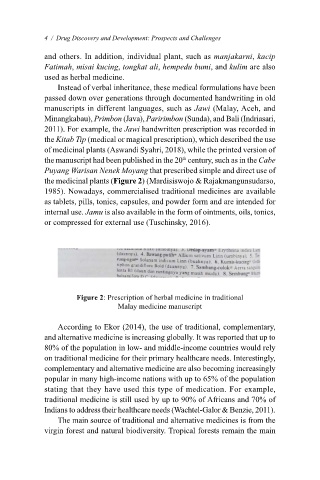
             Puyang Warisan Nenek Moyang that prescribed simple and direct use of
             the medicinal plants (Figure 2) (Mardisiswojo & Rajakmangunsudarso,
             1985). Nowadays, commercialised traditional medicines are available
             as tablets, pills, tonics, capsules, and powder form and are intended for
             internal use. Jamu is also available in the form of ointments, oils, tonics,
             or compressed for external use (Tuschinsky, 2016).


                     Figure 2: Prescription of herbal medicine in traditional Malay medicine manuscript
                      Figure 2: Prescription of herbal medicine in traditional

                                 Malay medicine manuscript
                    According to the Ekor (Ekor, 2014), the use of traditional, complementary, and alternative
                 According to Ekor (2014), the use of traditional, complementary,
                medicine is increasing globally. It was reported that up to 80% of the population in low- and middle-
                income countries would rely on traditional medicine for their primary healthcare needs. Interestingly,
             and alternative medicine is increasing globally. It was reported that up to
                complementary and alternative medicine are also becoming increasingly popular in many high-income
             80% of the population in low- and middle-income countries would rely
                nations with up to 65% of the population stating that they have used this type of medication. For
             on traditional medicine for their primary healthcare needs. Interestingly,
                example, traditional medicine is still used by up to 90% of Africans and 70% of Indians to address
             complementary and alternative medicine are also becoming increasingly
                their healthcare needs (Wachtel-Galor & Benzie, 2011).
             popular in many high-income nations with up to 65% of the population
                    The main source of traditional and alternative medicines is from the virgin forest and natural
             stating that they have used this type of medication. For example,
                biodiversity. Tropical forests remain the main source of trees, which contributed to the global supply
                of medicinal and aromatic plants (Figure 3). In the current scenario, we should focus our attention on
             traditional medicine is still used by up to 90% of Africans and 70% of
                the crucial yet delicate relationship between traditional medicine and modern therapy. Would we be
             Indians to address their healthcare needs (Wachtel-Galor & Benzie, 2011).
                able to guarantee the sustainability of traditional and alternative drug sources from nature given the
                 The main source of traditional and alternative medicines is from the
                increasing concern over the global environmental crisis, such as deforestation and climate change?
             virgin forest and natural biodiversity. Tropical forests remain the main
                According to reports, the rate of deforestation between 2015 and 2020 is expected to reach 10 million
                hectares per year, while primary forests have been reduced by nearly 80 million hectares owing to the
                rapid agricultural growth since 1990 (FAO, 2020).


                                                                          9

