


Page 17 - Drug Discovery and Development: Prospects and Challenges
P. 17
cancer (USD 10.69 billion) products. At the time of this writing, the COVID-19 vaccine is being
           developed by Johnson & Johnson using vector technology and it is scheduled for release in the first
           quarter of 2021 for emergency use  (Figure  4)  (Pharmaceutical Technology, 2021).  In  terms  of
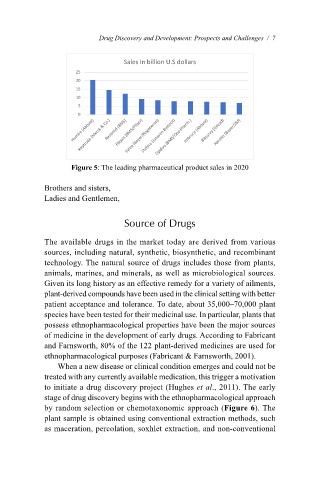
           individual drugs, Humira by Abvvie was the best-selling pharmaceutical drug in 2020 with USD 20.4
           billion in sales. Approved in 2002 in the United States, Humira is a prescription drug that is used to
           treat rheumatoid and psoriatic arthritis through subcutaneous injection. The drug is also used to treat
           autoimmune diseases, such as Crohn's disease, ankylosing spondylitis, ulcerative colitis, psoriasis,
           uveitis, and others. Besides Humira, the highest selling pharmaceutical products include Eliquis and
           Revlimid, which are used to treat multiple chronic conditions or cancer (Figure 5) (Pharmaceutical
           Technology, 2021).
                         60
                         50
                         40
                         30
                         20
                         10
                          0
                                              GlaxoSmithKline
                       Johnson & Johnson  Pfizer  Roche  Novartis Revenue (bn)  Sanofi  AbbVie  Takeda  Shanghai…
                                           Merck & Co.

                            Drug Discovery and Development: Prospects and Challenges  /  7
                   Figure 4: Top ten pharmaceutical companies with the highest revenue in 2020
                                  Sales in billion U.S dollars
                      25
                      20
                      15
                      10
                      5
                      0
                       Keytruda (Merck & Co.)
                     Humira (Abbvie)  Revlimid (BMS) Eylea (Bayer/Regeneron) Opdivo (BMS/Ono Pharm.) Imbruca (Abbvie) Biktarvy (Gilead)
                                                           Xarelto (Bayer/J&J)
                                        Stelara (Janssen Biotech)
                                 Eliquis (BMS/Pfizer)

                    Figure 5: The leading pharmaceutical product sales in 2020
                         Figure 5: The leading pharmaceutical product sales in 2020

             Brothers and sisters,
              Ladies and Gentlemen,                                         11
                                   Source of Drugs
             The available drugs in the market today are derived from various
             sources, including natural, synthetic, biosynthetic, and recombinant
             technology. The natural source of drugs includes those from plants,
             animals, marines, and minerals, as well as microbiological sources.
             Given its long history as an effective remedy for a variety of ailments,
             plant-derived compounds have been used in the clinical setting with better
             patient acceptance and tolerance. To date, about 35,000–70,000 plant
             species have been tested for their medicinal use. In particular, plants that
             possess ethnopharmacological properties have been the major sources
             of medicine in the development of early drugs. According to Fabricant
             and Farnsworth, 80% of the 122 plant-derived medicines are used for
             ethnopharmacological purposes (Fabricant & Farnsworth, 2001).
                 When a new disease or clinical condition emerges and could not be
             treated with any currently available medication, this trigger a motivation
             to initiate a drug discovery project (Hughes et al., 2011). The early
             stage of drug discovery begins with the ethnopharmacological approach
             by random selection or chemotaxonomic approach (Figure 6). The
             plant sample is obtained using conventional extraction methods, such
             as maceration, percolation, soxhlet extraction, and non-conventional

