


Page 43 - Drug Discovery and Development: Prospects and Challenges
P. 43
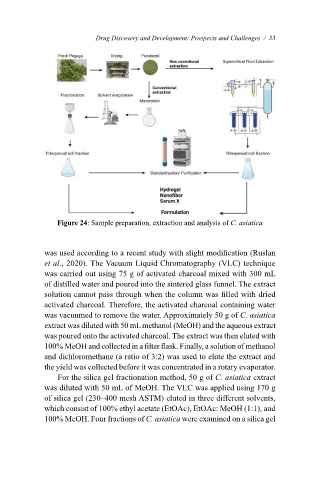
and evaporated using a rotary evaporator to obtain the extract in powder form (Figure 24) (Azis et al.,
            2017; Ahmed et al., 2019).
                 The non-conventional extraction method was  also  performed  using the  supercritical fluid
            extraction, which was screened using the two-level factorial design and optimised through the Central
            Composite Design  (CCD)  method  by altering three factors (co-solvent percentage, pressure, and
            temperature) on the asiaticoside content.  The model  obtained  was  used to  optimise  the extraction
                           Drug Discovery and Development: Prospects and Challenges  /  33
            process C. asiatica to obtain a higher yield of asiaticoside fraction (Ruslan et al., 2020).


                Figure 24: Sample preparation, extraction and analysis of C. asiatica
                      Figure 24: Sample preparation, extraction and analysis of C. asiatica

            Optimisation of Fractionation
             was used according to a recent study with slight modification (Ruslan
                 Two fractionation methods were performed for the optimisation of pegaga extract, which is the
             et al., 2020). The Vacuum Liquid Chromatography (VLC) technique
            fractionation using activated charcoal and fractionation using silica gel.  In the first  fractionation,
             was carried out using 75 g of activated charcoal mixed with 300 mL
            activated charcoal was used according to a recent study with slight modification (Ruslan et al., 2020).
             of distilled water and poured into the sintered glass funnel. The extract
            The  Vacuum Liquid Chromatography  (VLC)  technique was carried out  using 75 g  of  activated
             solution cannot pass through when the column was filled with dried
            charcoal mixed with 300 mL of distilled water and poured into the sintered glass funnel. The extract
             activated charcoal. Therefore, the activated charcoal containing water
            solution cannot pass through when the column was filled with dried activated charcoal. Therefore, the
             was vacuumed to remove the water. Approximately 50 g of C. asiatica
             extract was diluted with 50 mL methanol (MeOH) and the aqueous extract
                                                                           37
              was poured onto the activated charcoal. The extract was then eluted with
             100% MeOH and collected in a filter flask. Finally, a solution of methanol
             and dichloromethane (a ratio of 3:2) was used to elute the extract and
             the yield was collected before it was concentrated in a rotary evaporator.
                 For the silica gel fractionation method, 50 g of C. asiatica extract
             was diluted with 50 mL of MeOH. The VLC was applied using 170 g
             of silica gel (230–400 mesh ASTM) eluted in three different solvents,
             which consist of 100% ethyl acetate (EtOAc), EtOAc: MeOH (1:1), and
             100% MeOH. Four fractions of C. asiatica were examined on a silica gel

