


Page 38 - Drug Discovery and Development: Prospects and Challenges
P. 38
China and Madagascar, C. asiatica has caught our attention to study its unique properties. The herb
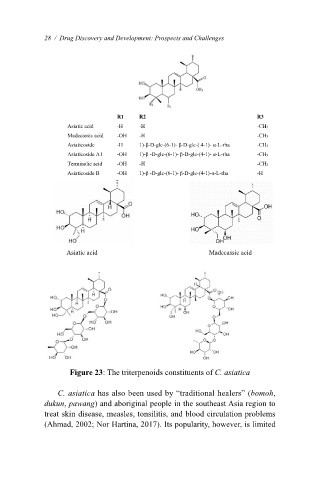
           possesses active principles comprising triterpenoids, such as asiaticoside, madecassoside, and asiatic
           acid (Figure 23). The huge attention on this plant is related to its activity on skin generation, boosting
           memory, increasing concentration and alertness, and anti-stress. During the wound healing process, C.
           asiatica stimulates collagen synthesis, which allows the skin to proliferate effectively.
             28  /  Drug Discovery and Development: Prospects and Challenges


                                 R1    R2                             R3
                   Asiatic acid   -H   -H                             -CH3
                   Madecassic acid   -OH   -H                         -CH3
                   Asiaticoside   -H   1)-β-D-glc-(6-1)- β-D-glc-( 4-1)- α-L-rha   -CH3
                   Asiaticoside A1   -OH   1)-β -D-glc-(6-1)- β-D-glc-(4-1)- α-L-rha   -CH3
                   Terminolic acid   -OH   -H                         -CH3
                   Asiaticoside B   -OH   1)-β -D-glc-(6-1)- β-D-glc-(4-1)-α-L-rha   -H


                            Asiatic acid                                           Madecassic acid


                    Figure 23: The triterpenoids constituents of C. asiatica
                                                                                 33
                 C. asiatica has also been used by “traditional healers” (bomoh,
             dukun, pawang) and aboriginal people in the southeast Asia region to
             treat skin disease, measles, tonsilitis, and blood circulation problems
             (Ahmad, 2002; Nor Hartina, 2017). Its popularity, however, is limited

