


Page 13 - GeoPRISMS_Newsletter_Spring2019_42_Neat
P. 13
ΔT (K)
               300     150    100          50
            60                                    60
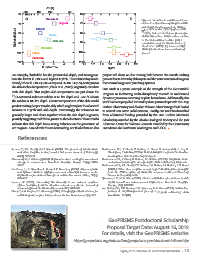
                a            Cleveland                                          b      Figure 5. Variation in volatile and trace
            70                       Seguam       70                                   element compositions of magmas with
                                                                                       slab depth (Rasmussen et al., 2018a).
                                                                                       (a) H O/Ce and H O/K O (agrees with
                       Okmok
          Slab depth (km)  80  Akutan             80                                   H O/Ce, but not shown) are proxies for
                                                                                                       2
                                                                                                    2
                                                                                           2
                                                                                         2
                                                                                       slab temperature. Temperature relative
                                                                                       to the wet sediment solidus (ΔT) is
                                 Makushin
                                                                                       calculated using the thermometer of
            90
                                                  90
                          Westdahl                                                     Plank et al. (2009). (b) Increased Dy/
                                                                                       Yb may indicate an increased role of
           100       Fisher                      100                                   garnet.
                     Shishaldin
           110                                   110
              0      1     2     3      4     5    1.6  1.7   1.8  1.9  2.0  2.1   2.2
                           H O/Ce * 10 -3                          Dy/Yb
                            2
        For example, Shishaldin has the greatest slab depth, and its magmas  project will focus on the missing link between the mantle melting
        have the lowest H O/Ce and highest Dy/Yb. This relationship holds  process that is driven by slab inputs and the water contents of magmas
                      2
        overall, where H O/Ce (1000-4500) and H O/K O (2-9), both proxies  that control magmatic plumbing systems.
                                        2
                                            2
                     2
        for slab surface temperature (Plank et al., 2009), negatively correlate   Our work is a prime example of the strength of the GeoPRISMS
        with slab depth. This implies slab temperatures are just above the   Program in facilitating multi-disciplinary research to understand
        H O-saturated sediment solidus at 65 km depth and ~250 °C above   dynamic processes occurring at plate boundaries. Additionally, this
          2
        the solidus at 100 km depth. Greater temperatures of the slab would   work has been propelled forward by close partnerships with the Deep
        predict melting deeper into the slab, which might explain the observed  Carbon Observatory and Alaskan Volcano Observatory, which has led
        increase in Dy/Yb with slab depth. Interestingly, the volcanoes are  to several new active collaborations. Finally, our work has benefited
        generally larger and closer together where the slab depth is greater,  from additional funding provided by the Don Richter Memorial
        possibly suggesting melt flux is greater in these locations. These results  Scholarship awarded by the Alaska Geological Society and the Jack
        indicate that slab depth has a strong influence on the generation of  Kleinman Grant for Volcano Research awarded by the Community
        arc magmas. Armed with this understanding, our final efforts on this  Foundation for Southwest Washington and USGS.  ■

            References


        Annen, C., J.D. Blundy, R.S.J. Sparks (2006). The genesis of intermediate   Rasmussen, D.J., T. Plank, D. Roman, E. Hauri, H. Janiszewski, E. Lev, K.
            and silicic magmas in deep crustal hot zones. Journal of Petrology,   Nicolaysen, P. Izbekov (2018a). How slab depth is reflected in Aleutian
            47(3), 505-539                                         Arc magmas. AGU Fall Meeting Abstracts
        Chaussard, E., F. Amelung (2014). Regional controls on magma ascent and   Rasmussen, D.J., T. Plank, D. Roman, M. Zimmer (2018b). Magmatic water
            storage in volcanic arcs. Geochem. Geophys. Geosys. 15(4), 1407-  content controls magma storage depth. AGU Fall Meeting Abstracts.
            1418                                               Rasmussen, D.J., T.A. Plank, D.C. Roman, J.A. Power, R.J. Bodnar, E.H. Hauri
        Hermann, J., C. Spandler, A. Hack, A.V. Korsakov, (2006). Aqueous fluids   (2018c). When does eruption run-up begin? Multidisciplinary insight
            and hydrous melts in high-pressure and ultra-high pressure rocks:   from the 1999 eruption of Shishaldin volcano. Earth and Planetary
            Implications for element transfer in subduction zones. Lithos, 92(3),   Science Letters, 486, 1-14
            399-417                                            Syracuse, E.M., G.A. Abers (2006). Global compilation of variations in slab
        Larsen,  J.F.  (2016).  Unraveling  the  diversity  in  arc  volcanic  eruption   depth beneath arc volcanoes and implications. Geochem. Geophys.
            styles: Examples from the Aleutian volcanic arc, Alaska. Journal of   Geosys., 7(5), Q05017
            Volcanology and Geothermal Research, 327, 643-668  van Keken, P.E., B.R. Hacker, E.M. Syracuse, G.A. Abers (2011). Subduction
        Plank, T., L.B. Cooper, C.E. Manning (2009). Emerging geothermometers for   factory:  4.  Depth-dependent  flux  of  H O  from  subducting  slabs
                                                                                                 2
            estimating slab surface temperatures. Nature Geoscience, 2(9), 611  worldwide. 116(B1)


                                                                   GeoPRISMS Postdoctoral Scholarship

                                                                  Proposal Target Date: August 16, 2019
                                                               For details, visit the GeoPRISMS website:

                                             http://geoprisms.org/education/geoprisms-postdoctoral-fellowship/


                                                                          Spring 2019  Issue No. 42  GeoPRISMS Newsletter  •  13

