


Page 11 - GeoPRISMS_Newsletter_Spring2019_42_Neat
P. 11
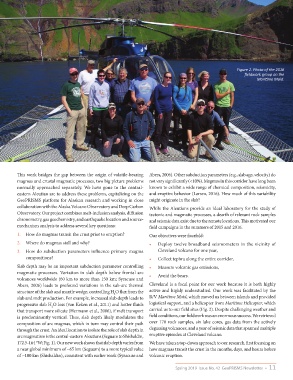
Figure 2. Photo of the 2016
                                                                                                       fieldwork group on the
                                                                                                            Maritime Maid.


        This work bridges the gap between the origin of volatile-bearing  Abers, 2006). Other subduction parameters (e.g., slab age, velocity) do
        magmas and crustal magmatic processes, two big picture problems  not vary significantly (<10%). Magmas in this corridor have long been
        normally approached separately. We have gone to the central-  known to exhibit a wide range of chemical composition, seismicity,
        eastern Aleutian arc to address these problems, capitalizing on the  and eruptive behavior (Larsen, 2016). How much of this variability
        GeoPRISMS platform for Alaskan research and working in close  might originate in the slab?
        collaboration with the Alaska Volcano Observatory and Deep Carbon   While the Aleutians provide an ideal laboratory for the study of
        Observatory. Our project combines melt-inclusion analysis, diffusion   tectonic and magmatic processes, a dearth of relevant rock samples
        chronometry, gas geochemistry, and earthquake location and source-  and seismic data exist due to the remote locations. This motivated our
        mechanism analysis to address several key questions:   field campaigns in the summers of 2015 and 2016.
        1.  How do magmas transit the crust prior to eruption?  Our objectives were fourfold:
        2.  Where do magmas stall and why?                     •   Deploy twelve broadband seismometers in the vicinity of

        3.  How do subduction parameters influence primary magma   Cleveland volcano for one year,
            compositions?                                      •   Collect tephra along the entire corridor,
        Slab depth may be an important subduction parameter controlling   •   Measure volcanic gas emissions,
        magmatic processes. Variation in slab depth below frontal arc   •   Avoid the bears.
        volcanoes worldwide (60 km to more than 150 km; Syracuse and
        Abers, 2006) leads to profound variations in the sub-arc thermal   Cleveland is a focal point for our work because it is both highly
        structure of the slab and mantle wedge, controlling H O flux from the   active and highly understudied. Our work was facilitated by the
                                                 2
        slab and melt production. For example, increased slab depth leads to   R/V Maritime Maid, which moved us between islands and provided
        progressive slab H O loss (van Keken et al., 2011) and hotter fluids   logistical support, and a helicopter from Maritime Helicopter, which
                       2
        that transport more silicate (Hermann et al., 2006), if melt transport   carried us to our field sites (Fig. 2). Despite challenging weather and
        is predominantly vertical. Thus, slab depth likely modulates the   field conditions, our fieldwork was an enormous success. We retrieved
        composition of arc magmas, which in turn may control their path   over 170 rock samples, six lake cores, gas data from the actively
        through the crust. An ideal location to isolate the role of slab depth in   degassing volcanoes, and a year of seismic data that spanned multiple
        arc magmatism is the central-eastern Aleutians (Seguam to Shishaldin,   eruptive episodes at Cleveland volcano.
        172.5-164 °W; Fig. 1). Our new work shows that slab depth varies from  We have taken a top-down approach to our research, first focusing on
        a near global minimum of ~65 km (Seguam) to a more typical value  how magmas transit the crust in the months, days, and hours before
        of ~100 km (Shishaldin), consistent with earlier work (Syracuse and  volcanic eruption.

                                                                          Spring 2019  Issue No. 42  GeoPRISMS Newsletter  •  11

