


Page 6 - GeoPRISMS_Newsletter_Spring2019_42_Neat
P. 6
Complex upper mantle structure beneath the


           East African Rift System


          Erica Emry (New Mexico Tech), Andrew Nyblade (Penn State University), and
          Yang Shen (University of Rhode Island)


              he East African Rift System (EARS) was one of the GeoPRISMS primary sites within the theme of Rift Initiation and Evolution,
              because of the variety of rifting stages and styles exhibited along this margin and because of the number of science questions that
        Tcan be addressed there. Along this margin and in neighboring regions of Africa, Europe, and the Middle East, many broadband
        seismic instruments have been previously deployed, and numerous studies have explored the subsurface structure over a broad range of
        scales. However, there is often a disjoint between features that had been previously imaged through smaller-scale, regional tomographic
        inversions and those imaged by larger-scale inversions. In a recent tomographic study of the upper mantle beneath Africa, we used a full-
        waveform tomography method, constrained by long-period signal from ambient seismic noise to image the upper mantle beneath Africa
        to the top of the mantle transition zone (Emry et al., 2019). We found good agreement with prior models, at both large and regional scales,
        and we imaged new features in higher detail beneath more poorly resolved segments of the EARS. Here, we highlight the overall patterns
        along the EARS and focus on the complexity observed beneath the Turkana region.

        What did we do?                                      −20˚          0˚          20˚          40˚          60˚

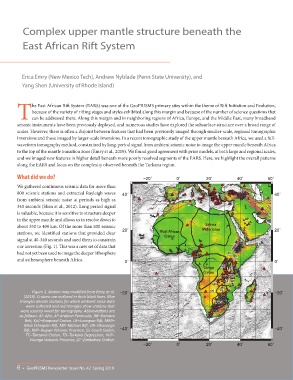
        We gathered continuous seismic data for more than
        800 seismic stations and extracted Rayleigh waves   40˚                                                     40˚
        from ambient seismic noise at periods as high as
        340 seconds (Shen et al., 2012). Long period signal
        is valuable, because it is sensitive to structure deeper
        in the upper mantle and allows us to resolve down to                                           AP
                                                                                       Sahara
        about 350 to 400 km. Of the more than 800 seismic                            Metacraton
        stations, we identified stations that provided clear   20˚  West African                                    20˚
                                                                      Craton
        signal at 40-340 seconds and used them to constrain                                          AF
        our inversion (Fig. 1). This was a new set of data that                                   MER
        had not yet been used to image the deeper lithosphere                                   SS
        and asthenosphere beneath Africa.            0˚                                           TD                0˚
                                                                                      Congo  VVP  TC
                                                                                      Craton
                                                                                                RVP
                                                                                               LR MR
                                                                                          DB
              Figure 1. Station map modified from Emry et al.   −20˚                     OR  ZC                     −20˚
           (2019). Cratons are outlined in thick black lines. Blue
         triangles denote stations for which ambient noise data                            KpC
            were collected and red triangles show stations that
          were used to invert for tomography. Abbreviations are
         as follows: AF-Afar, AP-Arabian Peninsula, DB–Damara
           Belt, KpC–Kaapvaal Craton, LR–Luangwa Rift, MER–
           Main Ethiopian Rift, MR–Malawi Rift, OR–Okavango
           Rift, RVP–Rugwe Volcanic Province, SS–South Sudan,   −40˚                                                −40˚
            TC–Tanzania Craton, TD–Turkana Depression, VVP–
             Virunga Volcanic Province, ZC–Zimbabwe Craton.
                                                             −20˚          0˚          20˚          40˚          60˚


        6  •  GeoPRISMS Newsletter  Issue No. 42  Spring 2019

