


Page 105 - analysis-and-interpretation-of-astronomical-sp
P. 105
Analysis and Interpretation of Astronomical Spectra                                        105

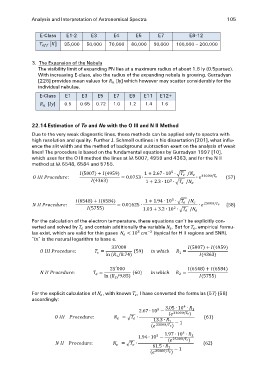
E-Class   E1-2     E3      E4                E5        E7 E8-12

         35,000  50,000  70,000            80,000    90,000 100,000 – 200,000

3. The Expansion of the Nebula
   The visibility limit of expanding PN lies at a maximum radius of about 1.6 ly (0.5parsec).
   With increasing E-class, also the radius of the expanding nebula is growing. Gurzadyan
   [226] provides mean values for [ly] which however may scatter considerably for the
   individual nebulae.

    E-Class E1 E3 E5 E7 E9 E11 E12+

                      0.5 0.65 0.72 1.0 1.2 1.4 1.6

22.14 Estimation of Te and Ne with the O III and N II Method

Due to the very weak diagnostic lines, these methods can be applied only to spectra with
high resolution and quality. Further J. Schmoll outlines in his dissertation [201], what influ-
ence the slit width and the method of background subtraction exert on the analysis of weak
lines! The procedure is based on the fundamental equations by Gurzadyan 1997 [10],
which uses for the O III method the lines at λλ 5007, 4959 and 4363, and for the N II
method at λλ 6548, 6584 and 5755.

For the calculation of the electron temperature, these equations can’t be explicitly con-
verted and solved by and contain additionally the variable . But for , empirical formu-

las exist, which are valid for thin gases            (typical for H II regions and SNR).

“ “ is the natural logarithm to base e.

For the explicit calculation of , with known , I have converted the formulas {57} {58}
accordingly:

